
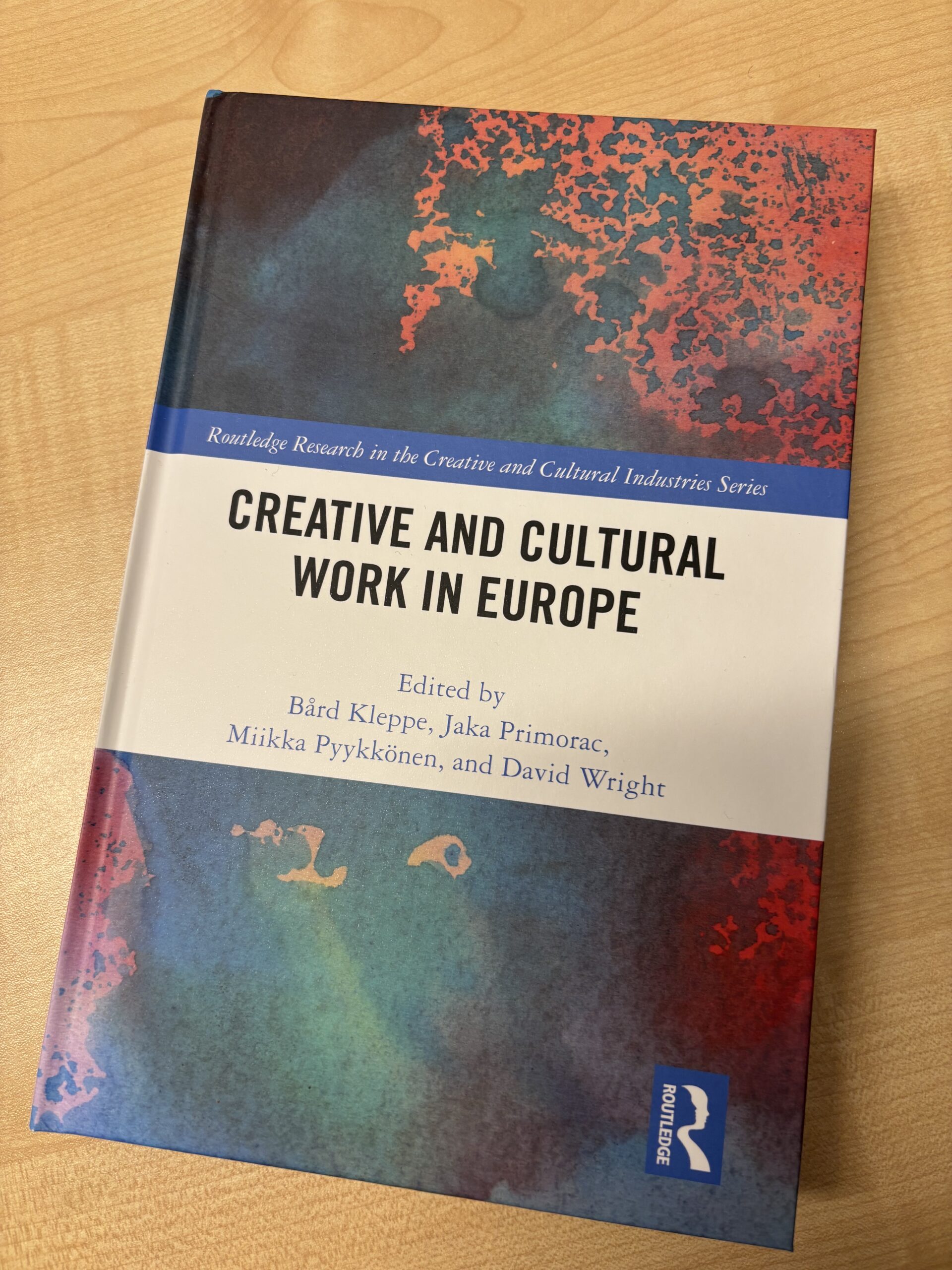
What is it like to work in the cultural and creative sectors in Europe today?
And what does it take to make such careers more sustainable?
These are the questions explored in the book Creative and Cultural Work in Europe, edited by Compendium experts Bård Kleppe (Norway) and Jaka Primorac (Croatia), together with Miikka Pyykkönen (Finland), and David Wright (UK). The book consists of 17 chapters written by researchers from across Europe.
Across the chapters, a clear pattern emerges: artistic and creative work differs from many other professions. It is characterised by unstable incomes, project-based work, and the need to combine multiple jobs. At the same time, many are driven by strong motivation and a sense of vocation.
A key insight is that creative work is difficult to measure and define. Official statistics often present a simplified picture, where very different types of jobs are grouped together. As a result, the creative economy may appear to generate more employment and value than it actually does. At the same time, important aspects of the work remain invisible—such as the time artists spend training, experimenting, and failing, or the unpaid labour involved in networking, administration, and applying for funding. This creates a paradox: many are willing to accept insecure working conditions and low incomes because the work is meaningful. Yet this also makes artists and creative workers vulnerable to exploitation and economic insecurity.
At the same time, the book shows that these challenges can be addressed—and even avoided. Several European countries, including Norway, have developed policies that take into account how creative work actually functions. Examples include artist grants, basic income schemes, assistant schemes, and various forms of long-term project funding. Such measures are based on the recognition that creative work has distinctive characteristics that require more flexible forms of support.
The book also emphasises the importance of collective organisation. Collaboration through trade unions and professional networks can contribute to better working conditions, more stable incomes, and the sharing of economic risk. Local and regional initiatives also play an important role, as they often have a closer understanding of artists’ real needs.
A central point is that how we understand creative work shapes policy. If it is seen primarily as an economic activity, the focus tends to be on productivity and profitability. If it is understood as a cultural practice, it becomes possible to value its intrinsic worth and the need for time, freedom, and experimentation. The challenge, however, is to reconcile these two perspectives.
Finally, the chapter raises a difficult but important question: are there simply too many people trying to make a living from creative work? If competition becomes too intense, it may undermine the sustainability of the field as a whole. This challenges both education systems and cultural policy to rethink who gains access to such careers—and under what conditions.
The conclusion is twofold: working conditions in the creative sectors remain challenging in many parts of Europe. But they can be improved. With the right policy measures, stronger collective organisation, and a deeper understanding of what creative work actually entails, it is possible to create more sustainable conditions for those who produce art and culture.
Comments are closed.