
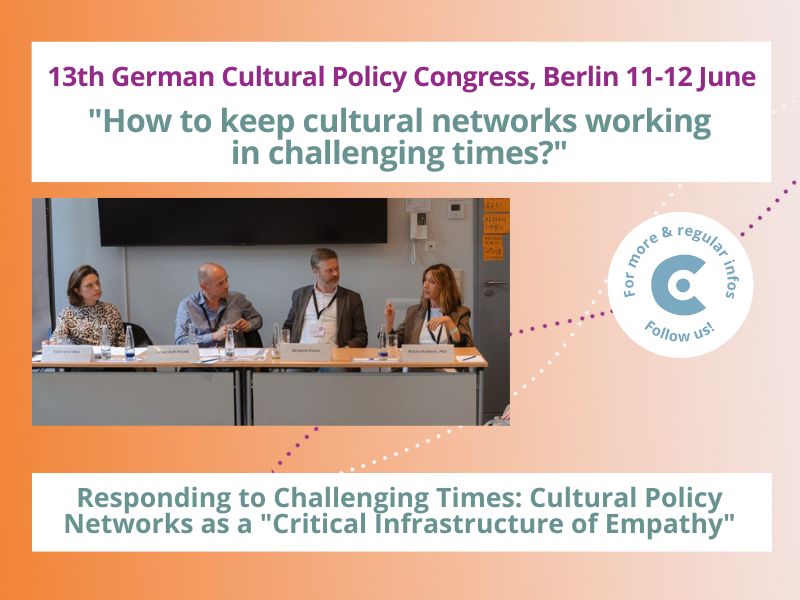
How can cultural and cultural-policy networks continue to function, adapt, and protect democratic values during times of intense social and political upheaval?
This central question anchored the forum “How to keep cultural (policy) networks working in challenging times?” at the recent 13th German Federal Cultural Policy Congress (Kulturpolitischer Bundeskongress). Organised collaboratively by the Creative Europe Desk KULTUR, Kontaktstelle CERV (Citizens, Equality, Rights and Values), and the Compendium of Cultural Policies and Trends, the panel brought together international experts to dissect the shifting realities of cultural cooperation.
This year’s Congress, which welcomed over 400 participants —coinciding with the 50th anniversary of the German Association for Cultural Policy (Kulturpolitische Gesellschaft)—was fittingly themed “Again(st) the Anger: Cultural-Policy Networks Against Authoritarianism” (Wi(e)der die Wut. Kulturpolitische Netzwerke gegen Autoritarismus). It directly explored how culture, education, and politics can actively restore public trust following collective experiences of crisis and loss.
Unpacking Realities: From the Balkan to Brexit
The discussion bridged several distinct political landscapes, with panellists drawing on lessons from “Brexit, the Balkans, and Budapest.“
-
Dr. Natasa Kraljevic, representing the ISCA Institute and the University “Mediterranean” Podgorica (Montenegro), highlighted historical and ongoing cultural cooperation in the former Yugoslav region. She emphasised that building mutual trust, nurturing long-term professional relationships, and maintaining regional partnerships are fundamental to overcoming geopolitical friction.
-
Katarzyna Sitko, Director of the Polish Institute in Berlin, powerfully captured the profound social weight of this work by defining cultural policy networks as a “critical infrastructure of empathy” (Kritische Infrastruktur der Empathie).
-
Benjamin Feyen, a Brussels-based expert specializing in UK–EU cultural relations, brought vital perspectives on navigating the institutional barriers and structural disconnects left in the wake of Brexit.
Key Takeaways for Building Resilient Networks
The panel moved past generalities to offer concrete, actionable insights for cultural managers and policymakers facing rising authoritarianism and polarization:
-
Prioritize Values Over Funding: Build networks rooted deeply in solidarity, shared values, and idealism rather than focusing solely on optimized funding prospects. These networks must intentionally cross national, disciplinary, and ideological boundaries early on—before major crises hit.
-
Learn from Transnational Experiences: While certain regions face growing political pressure, speakers noted that countries like Germany can look to the experiences of Poland, Hungary, or Brazil. Recognizing tactics such as progressive restriction or systemic pressure allows networks to learn from past mistakes and avoid repeating them.
-
Adjust Expectations to Build True Resilience: Resilience does not mean assuming a crisis-free future. True systemic resilience comes from accepting volatile environments, reducing expectations of a smooth path forward, and focusing deliberately on executing core cultural duties.
-
Actively Resist Self-Censorship: The ultimate antidote to self-censorship, preemptive obedience, and the “internal scissors” (die Schere im Kopf) is a vigilant, value-based professional stance.
Ultimately, the forum concluded that the survival and impact of the cultural sector rely heavily on continuous investment in collective action, knowledge exchange, and an unyielding commitment to preserving openness and freedom of expression.
The Compendium of Cultural Policies and Trends is proud to have co-organised this vital exchange. We extend our warmest thanks to our partners, panellists, and all attendees who contributed to these crucial conversations.
Comments are closed.