
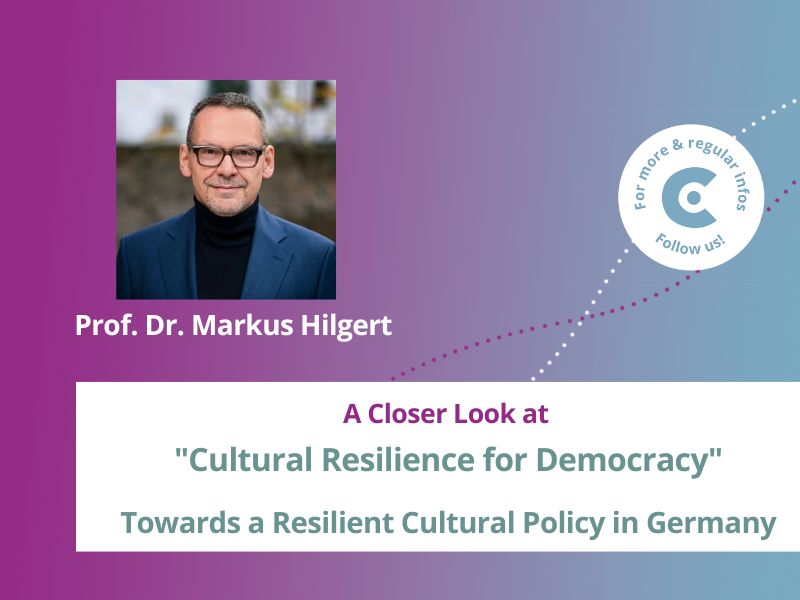
Cultural Resilience for Democratic Stability – Towards a Resilient Cultural Policy in Germany
In our series “A Closer Look at…”, we are introducing an article from Prof. Dr Markus Hilgert, a visionary voice for cultural policy and resilience.
At a moment when democratic societies face multi-layered geopolitical, social, and environmental challenges, understanding the pivotal role of culture in preserving social cohesion is more urgent than ever.
We are pleased to highlight an English version of the recent work of Prof. Dr Markus Hilgert, a distinguished leader, scholar, and advocate in the field of cultural policy and the president of the Kulturpolitische Gesellschaft e.V..
Prof. Dr Markus Hilgert brings deep expertise in cultural governance, heritage protection, and civilizational memory. In his latest publication, “Cultural Resilience for Democratic Stability: Towards a Resilient Cultural Policy in Germany“ (originally published in Kulturpolitische Mitteilungen 193, 2026), Hilgert formulates a compelling framework designed to safeguard democratic institutions by fortifying the cultural sector.
Key Highlights of Hilgert’s “Cultural Policy for Resilience” Framework
Prof. Dr Hilgert argues that cultural ecosystems face a dual vulnerability: a historical, structural precarity within the cultural sector itself, coupled with cross-sectoral societal crises (such as geopolitical conflicts, pandemics, and anti-democratic pressures). To address this, he outlines eight evidence-based success factors and operational guidelines to shift cultural funding away from short-term project logics toward long-term institutional stability:
- Cultural Infrastructure as Public Provision: Treating spaces like libraries, theatres, and museums as vital public infrastructure that provides stability, routine, and trust during times of crisis.
- Symbolic Repair & Memory: Leveraging policies of remembrance and shared historical narratives to support democratic reconstruction and process collective trauma.
- Decentralisation & Redundancy: Promoting polycentric, multi-tiered governance structures across municipal, state, and federal levels to prevent single points of failure and increase adaptive capacity.
- Cross-Sectoral Integration: Embedding cultural policy directly into broader public policy domains, including health, education, urban planning, and social security.
- Protecting Artistic Freedom: Emphasising that resilient cultural policy creates open spaces of possibility and supports the conditions of freedom, rather than instrumentalising art for political agendas.
To bridge vision and practice, Hilgert recommends immediate, practical “quick wins”—such as rapid-response packages for cultural institutions, Cultural Safeguarding Audits, and Resilience Fellowships for participatory community artists—alongside structural initiatives like a National Resilience Fund for Culture.
Prof. Dr Markus Hilgert’s forward-thinking contribution intends to enrich contemporary debates and policy discourses on how cultural ecosystems can actively secure democratic resilience, stability, and human coexistence for the future.
Comments are closed.