
1. Cultural policy system
Sweden
Last update: February, 2024
Historical background
The oldest cultural institutions in Sweden can be traced back several hundred years. The National Archives and the National Heritage Board have predecessors at least back to the 17th century, the royal theatres, and many of royal academies. were created in the 18th century, and the national museums of history and art, as well as several other institutions, were founded in the 19th century. Such institutions were the product of a unitary state, expressing first the cultural ambitions of the royal court, and later the identity of Sweden as a nation state.
Cultural education, public museums, concert halls and public libraries were favoured areas of cultural policy in the early 20th century, typically with substantial contributions from private patrons and voluntary work. In the 1930s, the democratic welfare state began to evolve with an increasing government involvement in arts and culture. During the same period, the efforts in popular cultural education made by popular movements, such as the labour movement, the temperance movement, and the non-conformist Christian movement, solidified into government-funded organisations. Since the 1930s, the main feature of Swedish cultural policy has been an emphasis on equal access to quality culture. One initiative typical of the early welfare state was the National Touring Theatre (Riksteatern), created in 1934.
1950-1970: Social Democratic governments continued to expand the state to create an all-encompassing welfare system. Established cultural institutions were modernised, and new ones were created, e.g. touring institutions for exhibitions and music, the Film Institute, and municipal music schools. Among the first new bodies of cultural policy was the Author's Fund, created in 1954 to distribute government grants to writers, established as a support system based in cultural policy and a compensation for the right of public libraries to lend out books.
1970-1990: In the 1960s, political debate focusing on cultural policy increased dramatically, resulting in the first general cultural policy objectives, in the Government Bill on Culture of 1974. The democratic welfare-state model of cultural policy was now institutionalised. A new government agency, the Swedish Arts Council, was also created. While the objectives of cultural policy established at that time were the results of an initiative of the national government, the most significant result may have been the substantial strengthening of regional and municipal resources for the production and distribution of quality culture.
The Ministry of Culture was separated from the Ministry of Education in 1991. Many participatory cultural activities are still the responsibility of the Ministry of Education, as is artistic education. The two fields thus remain closely linked.
2000-2023: In the 2000’s, regional governments became increasingly active in Swedish cultural policy, both in creating their own cultural policies, and in distributing funding from the national budget. In 2009, a new Government Bill on Cultural Policy was passed by Parliament, setting new objectives for cultural policy, and creating a new and more decentralised organisation for government support of arts and culture. As a result, a significant part of the national funding for culture was transferred to regional governments. Under this model – known as the Culture Cooperation Model – the Swedish Arts Council acts as a representative of the national government in approving the Cultural Policy Plans of the regional governments for national funding. In the making of their Cultural Policy Plans, regional governments are obligated to consult with representatives of cultural institutions, professionals and civil society in their respective regions.
Main features of the cultural policy model
The Swedish cultural policy model is characterized by a strong national level, with most of its powers invested in government agencies under the leadership of government-appointed directors and boards. Such boards, like the bodies of experts assisting such bodies, often include representatives of relevant sub-fields and professions within the field of arts and culture. The complexity of the Swedish cultural policy model is a result of the large number of heterogeneous units directly subordinated, and/or financially dependent on, the Ministry of Culture. Among the most important such bodies are the Swedish Arts Council, the Swedish Arts Grants Committee, and the Swedish Heritage Board. Other large public bodies are the Swedish Film Institute (see chapter 1.2.2), and the government agencies responsible for various museums and other cultural institutions (see chapter 1.3).
The autonomy of cultural institutions organized as government agencies is protected by constitutional law. In addition, there is a tradition of respect for the autonomy of artists and cultural professionals in matters of content and quality of cultural production. This can be described as a double arm’s length principle. Safeguards against political intervention in the practices of publicly owned and/or publicly financed cultural institutions are relatively strong. The autonomy of cultural institutions on the regional and local levels is not constitutionally protected.
In the Government Bill on Cultural Policy of 2009 (2009/10:3), the previous focus on the national level of cultural policy was somewhat changed. Since then, a new system has been introduced, in which national government funding of regional institutions is governed through regional Cultural Policy Plans approved by the Swedish Arts Council. In a recent inquiry report, several changes to this model were proposed, and it has been announced that a plan for reforming it will be presented by the government. Among the proposals in the report is a new law, which would, among other things, protect the arm’s length principle on the regional level (see chapter 1.2.3 and 1.2.6).
Cultural education is largely outside of the responsibility of the Ministry of Culture. Instead, higher artistic education is integrated in the university system, a responsibility of the Ministry of Education. Lower level culture and music schools are a common area of activity for the municipalities. The Ministry of Education also supports national study associations and folk high schools, also often dealing with cultural activities and cultural education (see chapter 5).
Cultural policy objectives
Swedish cultural policy has a long-standing focus on equal access to, and participation in, arts and culture, as well as on government support for artists.
The current objectives for cultural policy, listed below, were established with the government bill on cultural policy of 2009 (prop. 2009/10:3). Specific goals also exist for some parts of the arts and culture sector. These goals are described in this Compendium profile under the headlines for these specific areas.
“Culture should be a dynamic, challenging, and independent force based on the freedom of expression. Everyone should be able to participate in cultural life. Creativity, diversity and artistic quality should mark society's development.
To reach the objectives cultural policy should:
- promote everyone's opportunity to cultural experiences, cultural education, and to develop their creative capabilities;
- promote quality and artistic renewal;
- promote a living cultural heritage, which is preserved, used, and developed;
- promote international and intercultural exchange and cooperation; and
- especially notice the right to culture of children and the young.”
Last update: February, 2024
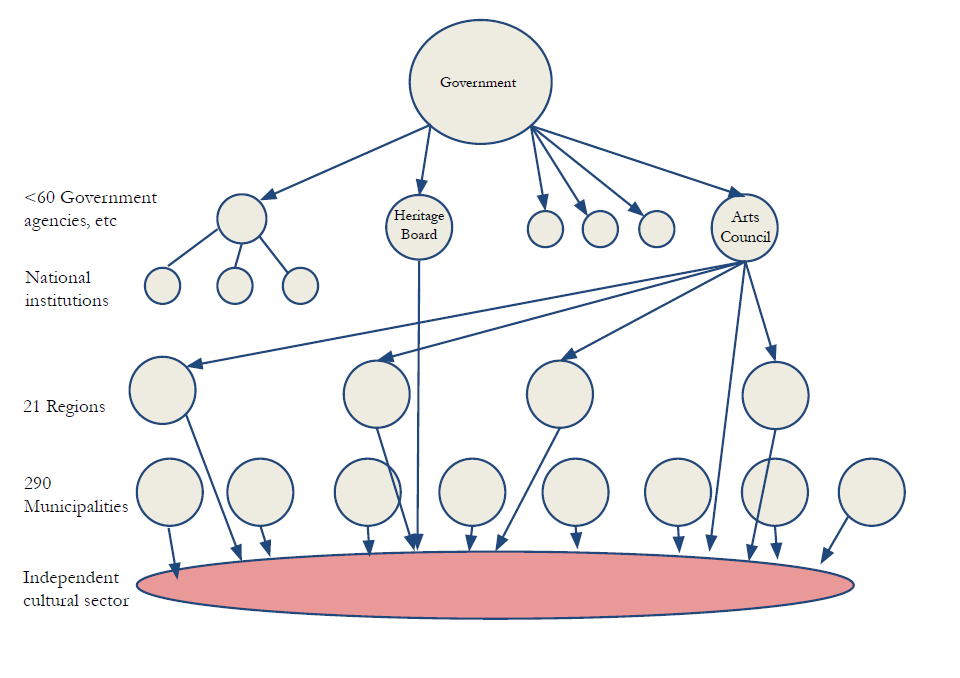
Overall picture of the relationship between different levels of government and arm's-length government agencies and cultural institutions at the national level (arrows indicating funding).
Last update: February, 2024
Sweden is a unitary state with certain autonomy for local and regional governments guaranteed by its Instrument of Government (one of its Fundamental Laws). In total, the national government provided 48 percent of public expenditure on culture in 2022. Most of the practical work of the national government is carried out by government agencies. These receive formal instructions decided in government decisions within a framework decided by Parliament. The main actors in Swedish cultural policy on the national level include the following:
The Parliament (Riksdagen) elects the government, legislates and decides on the national budget, including the general policies, and provisions for government agencies (including some of the major cultural institutions). The national government's principal responsibility within cultural policy is proposing legislation and the national budget, as well as co-ordinating and long-term planning cultural policy via the appropriate ministries and related bodies.
The Ministry of Culture is responsible for the arts, cultural heritage, media, national minorities, civil society, and democracy. It prepares government bills concerning these areas, and co-ordinates government agencies. More than 40 government agencies report to the Ministry of Culture. The main agencies dealing with cultural policy are described in this chapter. Government agencies responsible to the Ministry of Culture include many of the more than 30 museums financed directly by the state. Directly responsible to the Ministry of Culture is also The Royal Opera and The Royal Dramatic Theatre. Through its grants to regional governments, the state supports a large number of regional museums, theatres and other cultural institutions.
The Ministry of Education and Research is responsible for education on all levels, including cultural education and education in the arts.
The Ministry of Climate and Enterprise is responsible for supporting business and innovation in various sectors, including cultural and creative industries.
The Swedish Arts Council (Kulturrådet) is a government agency reporting to the Ministry of Culture. It allocates funds to organizations in accordance with cultural policy, for a number of purposes. The Council is responsible for:
- the allocation of state cultural funding to theatre, dance, music, literature, arts periodicals and public libraries, and to the fine arts, museums and exhibitions;
- providing the Swedish government with the basic data it needs to make cultural policy decisions, by evaluating state spending in the cultural sphere, etc;
- providing information on culture and cultural policy; and
- approving regional cultural plans before allocating national funding to the regional level.
In it's bill on the national budget for 2024 (Prop. 2023/24:1), the government announced that The Swedish Arts Council and The Arts Grants Committee (Konstnärsnämnden) will be assigned the task of presenting plans for a possible merger of the two agencies.
The National Heritage Board (Riksantikvarieämbetet) is a government agency reporting to the Ministry of Culture. It serves as Sweden's central administrative agency in the area of cultural heritage and historic environments. Among its activities are initiatives aiming to protect historic environments, preservation, conservation, interagency coordination, and the accumulation, and dissemination, of information in these areas. Since 2017, the National Heritage Board also has responsibility for coordinating and developing museums and museum policy.
Swedish Arts Grants Committee is a government agency that distributes state scholarships and grants to individual artists working in the visual arts, design, music, dance, theatre and film.
The Swedish Agency for Cultural Policy Analysis (Myndigheten för kulturanalys) was established in 2011 to gather information on arts and culture, follow relevant research, analyse information and evaluate cultural policy. It is also responsible for statistics within the area of cultural policy. It reports biannually to the government.
The Royal Library (Kungliga biblioteket) is a government agency reporting to the Ministry of Education. It is responsible for the national library of Sweden, collecting all works published in the country, as well as a number of other categories of relevant material and media. It is also responsible for official statistics and coordination regarding public libraries in Sweden. On issues regarding public libraries, The Royal Library reports to the Ministry of Culture.
The Sámi Parliament (Sametinget) is an elected body acting as a representative body for the Sámi people in Sweden. The Sámi Parliament supports professional skills development, as well as Sámi culture and language. The role of the Swedish Sámi Parliament is regulated in Swedish law and financed through the Swedish national budget. Similar Sámi parliaments also exist in Norway and Finland.
The Swedish Film Institute (Svenska Filminstitutet, SFI) is a government funded foundation responsible for the promotion, support and development of Swedish film, the allocation of grants for the production, distribution and exhibition of Swedish films, and the promotion of Swedish cinema abroad.
The Swedish Institute (Svenska Institutet, SI), together with the Swedish Arts Council, is responsible for supporting and initiating activities promoting international cultural exchanges (see also 1.4.1).
The Swedish Media Council (Statens Medieråd) is a government agency established in 2011, when the National Board of Film Classification was merged with former Swedish Media Council. Its objectives include reducing the risk of harmful media influences on minors and empowering minors as conscious media users. The agency is to be merged with The Swedish Press and Broadcasting Authority by January 1st, 2024.
Swedish Television (Sveriges Television, SVT) is the Swedish public service TV broadcaster. It is organized as a public limited company, and funded by a special tax on personal income. Together with the other two public broadcasters, Swedish Radio (Sveriges Radio) and Swedish Educational Broadcasting Company (Sveriges Utbildningsradio), it is owned by an independent foundation. The foundation's board is appointed by the national government and consists of 13 representatives of the political parties in the Riksdag. The foundation in turn appoints the members of the SVT board.
The Arts Grants Committee (Konstnärsnämnden), The Authors' Fund (Författarfonden), and The National Public Arts Council (Statens konstråd) are agencies responsible for various kinds of grants to support authors and other artists.
Last update: February, 2024
Regions (regioner) are tax-levying authorities on the regional level headed by directly elected Regional Assemblies and Regional Councils appointed by these. Sweden has 21 such regions (including the island of Gotland, where Gotland Municipality also carries the responsibilities of a Region). Until 2020, regional authorities in Sweden were officially known as County Councils (landsting). The Regions are mainly responsible for health services, but also provide support for, among other things, regional theatres, orchestras, museums, and libraries (mainly regional library services and hospital libraries). Historically, this has meant that the role of regional authorities has been comparatively limited in cultural policy. This was changed following the 2009 Government Bill on Culture, and the subsequent introduction of the Culture Cooperation Model, under which each Regional Council submits a Culture Plan for the region to the Swedish Arts Council (see also chapter 1.2.6). In the making of their cultural policy plans, Regional Councils are obligated to consult with representatives of institutions, professionals, and civil society in arts and culture in their respective regions. After the plan has been approved, the Regional Council is granted government funding for the support of arts and culture in the region, including the regional cultural institutions. Their nationally funded work with cultural policy should support
- professional theatre, dance, and music,
- museums, and their work with the cultural environment,
- libraries, and activities supporting reading and literature,
- professional image and form art, and activities,
- private archives in the region,
- film cultural activities,
- support for crafts.
In 2011, this procedure was tested in five regions (West Sweden, Skåne, Norrbotten, Gotland, and Halland). Eleven more regions followed in 2012, leaving Stockholm Region, including the city of Stockholm, as the only region in which the model is yet to be implemented.
In July 2022, the government appointed an investigation to re-evaluate the Cultural Cooperation model. In the report published in September 2023, several changes to the model were proposed. A law on collaboration between state, region, and municipality in the cultural field should be introduced, simplifying the processes within the model, and guaranteeing artistic freedom in the regional and municipal activities funded through the model. The existing regional culture plans should be replaced with plans focusing on the state-funded parts of regional cultural policy. The Swedish Arts Council should be given full authority to represent the state in this area, and new artistic and cultural areas should be possible to include in the plans (SOU 2023:58).
Regional governments provide 14 percent of the total public expenditure on culture.
The County Administrative Boards (länsstyrelser) are 21 government agencies representing the national government on the regional level on issues for which there is no other body of the national government on that level. This includes responsibilities in the areas of natural environment and cultural heritage (since the National Heritage Board does not have regional branches). Each County Administrative Board is headed by a County Governor (landshövding) appointed by the national government.
Last update: February, 2024
The 290 Municipalities (kommuner) of Sweden, are tax levying, local authorities headed by elected assemblies, which elect Municipal Councils. They are legally obligated to fund at least one public library (see chapter 3.2), but they also fund other cultural activities, such as culture and music schools (see chapter 5.4), theatres, art galleries, museums, and popular cultural education (see chapter 6.4). Municipalities are also responsible for regular schools, up to, but not including university level education. Funding comes mainly from locally derived municipal income, i.e., primarily taxes (additional resources may be allocated by the national government). The main areas for municipal activities in the cultural sphere – apart from organizing the regular school system – are libraries, culture and music schools, and support for local NGOs, but larger municipalities may organize a significantly broader range of cultural institutions and programmes.
Swedish municipalities vary greatly in size and population – ranging from Bjurholm, with 2,363 inhabitants, to Stockholm, with 987,661, and from Sundbyberg, with 6,341 inhabitants/km2, to Arjeplog with 0.21 – as well as in the range of their cultural activities. Sweden as a whole is the second least densely populated country in the EU. Factors such as employment and the medium income of inhabitants also vary greatly. Such differences force some municipalities to focus on creating access to cultural institutions and activities over great distances, while larger cities have the ability to maintain large institutions, and grants for arts and civil society. Some suburban municipalities rely on the cultural resources of a larger city, while others have ambitious cultural policies adapting to increasing cultural diversity.
Local governments provide 38 percent of the total public expenditure on culture.
Last update: February, 2024
Voluntary associations have historically played an important role in Swedish society and politics, often in close cooperation with the state. However, in many areas this role is mostly limited to acting as advocacy groups, leaving welfare arrangements to the state. Leisure activities are one of the exceptions to this rule. Consequently, organizations relevant to cultural policy are in most cases concerned either with advocacy or with organizing leisure activities. On the advocacy side, organizations representing the professionals of the culture sector and the various art forms play a significant role by being consulted during the process of policy formation, as well as by being represented in committees and boards within the sector.
The Swedish voluntary sector, and the approaches to it taken in government policy, has long been dominated by organizations sharing several organizational characteristics:
- they have equal membership open to everyone who wants to join;
- they have hierarchic and democratic federal structures divided in regional districts that are, in turn, based on local clubs;
- they have a high number of individual members who form the basis of the organization’s internal democracy; typically covering the whole nation geographically, and only the nation;
- they, to a high degree, rely on voluntary work,
- the state contributes a significant part of their income; and
- they are often closely integrated in government and are, for example, typically consulted by the government before new legislation is proposed to the Parliament
Such organizations are often described as popular movement organizations (folkrörelseorganisationer). This way of organizing is enforced by strong links to the nation-state, as well as to its regional authorities and municipalities.
A slightly different form than the typical Swedish NGO structure is the study association. These are more complex in structure. They are also the economically dominant form of organization in the field of cultural amateur activities. While they are government-funded, non-profit membership-based organizations, their members include federations of voluntary organizations of the popular movement type. Their function is to offer popular education activities to the members of these organizations, as well as to the general public. Since 1991, their national government funding – 4,3 billion SEK in the budget bill for 2024 – is distributed by the Swedish National Council of Adult Education (Folkbildningsrådet). The Council is a non-profit association with three official members: the National Association of Local and Regional Authorities (representing the large number of folk high schools organized by regional governments), the Interest Organization of Popular Movement Folk High Schools (representing the folk high schools organized by voluntary organizations), and the Swedish National Federation of Study Associations (Folkbildningsförbundet, representing the study associations). Most of the established voluntary organizations of the country are involved in these structures, generally as members of study associations. In September, the government assigned a government inquiry to prepare a proposal for reforming the system. The inquiry was also instructed to consider the possibility of transferring the responsibility for allocating government funding in this area from the National Council for Adult Education to an existing government agency. The report from this inquiry is due in June 2024 (Dir. 2023:130).
Another exception from the typical case is the registered religious denominations. The largest of these is the Church of Sweden, with 5.5 million members. When analyzing trends in the Swedish voluntary sector, it is thus worth noting that the Church of Sweden was separated from the state in 2000 and is now a part of the voluntary sector. Even if one does not consider religious activities, as such, to be a part of the cultural sector, its activities still contain many aspects which could be characterized as arts and culture, e.g. church choirs, church music, and heritage preservation.
Last update: February, 2024
Since implementation of policies is typically a matter for government agencies rather than for the ministries themselves, inter-agency cooperation is much more common than direct inter-ministerial cooperation.
Cooperation between the national and regional levels in cultural policy is organised according to the Culture Cooperation Model (see also chapter 1.2.3). Under this model, nationally supported regional cultural policies are guided by regional Culture Plans prepared by the Regions and approved by the Swedish Arts Council. While preparing the Culture Plan, the Region should be in dialogue with civil society, professionals in arts and culture, and the municipalities of the region. In its work with Culture Plans and the Culture Cooperation Model, The Swedish Arts Council is supported by a Cooperation Council (samverkansråd) consisting of representatives of The Swedish Arts Council (chairing the council), The Arts Grants Committee (Konstnärsnämnden), The National Public Arts Council (Statens konstråd), The Royal Library (Kungliga biblioteket), the County Administrative Boards (länstyrelser), The National Swedish Handicraft Council (Nämnden för hemslöjdsfrågor), The National Touring Theatre (Riksteatern), The National Heritage Board (Riksantikvarieämbetet), The National Archives (Arkivverket), and the Swedish Film Institute (Filminstitutet).
Cultural aspects of foreign policy is another area for inter-ministerial cooperation, mainly between the Ministry of Culture, and the Ministry of Foreign Affairs. Cultural attachés are currently placed at the Swedish embassies in Beijing, Berlin, London, Moscow, Paris and Washington, at the consulate-general in Istanbul, and at the Swedish Permanent Representation to the European Union in Brussels. These representatives of Swedish culture are appointed by the Ministry of Culture but integrated in each embassy, part of the Ministry of Foreign Affairs (see 1.4.1). Together with the Swedish Film Institute, the Swedish Arts Council runs the Creative Europe Desk Sweden (see chapter 1.4.2).
Last update: February, 2024
Most major cultural institutions in Sweden are financed by the national, regional, or local levels of governments. Most of these are owned, and maintained, by public authorities. The majority of the national cultural institutions are located in the capital. The national government also contributes to regional and municipal cultural institutions (see chapters 1.2.3. and 1.2.6.).
National museums are under government authority, and most of them are organised as parts of government agencies. A few national museums have the legal status of foundations, but there is little practical difference in their relationship to the government. The government stipulates instructions and regulations, appoints boards, and supports them financially. For historical reasons, most cultural institutions are located in the capital. However, the newer Museum of World Cultures has its headquarters in Gothenburg, and the Maritime Museum is headquartered in the port city Karlskrona. Two national stages, the Royal Opera and the Royal Dramatic Theatre, are organised as limited liability companies, with the state as sole shareholder. These companies are not financially self-supporting; they receive 70-80 percent of their annual budgets from the state funds for culture. National public service TV and radio is organized in companies owned by a foundation with a board representing the parties represented in the national parliament.
Regional and municipal cultural institutions are mostly run as foundations, as limited liability companies, in which the Region and / or municipal authorities are the owners, or as integrated parts of regional or municipal administration. Access to EU Structural Funds, and earmarked money for cultural projects, has become increasingly important at these levels.
Last update: February, 2024
Table 1: Cultural institutions, by sector and domain
| Domain | Cultural institutions (subdomains) | Public Sector |
Private Sector |
||
| Number (2022 if nothing else noted) | Trend last 5 years | Number (year) | Trend last 5 years (in %) | ||
| Cultural heritage | Cultural heritage sites (recognised)* | 6003 | 7.8 % | 0 | 0 |
| Archaeological sites* | 685649 | 6.0 % | 0 | 0 | |
| Museums | Museum institutions* | 194 (2022) | 3.19 % | N/A | N/A |
| Archives | Archive institutions* | 312(2020) | N/A | N/A | N/A |
| Visual arts | Public art galleries / exhibition halls* | N/A | N/A | N/A | N/A |
| Performing arts | Scenic and stable spaces for theatre** | 52 | N/A | N/A | N/A |
| Concert houses** | 13 | N/A | N/A | N/A | |
| Theatre companies** | N/A | N/A | N/A | N/A | |
| Dance and ballet companies** | N/A | N/A | N/A | N/A | |
| Symphonic orchestras** | 14 | N/A | N/A | N/A | |
| Libraries | Libraries*** | 1084 (2021) | -4 % | 0 | 0 |
| Audiovisual | Cinemas**** | - | - | 478 (2020) | 14.4% |
| Broadcasting organisations***** | 2 | +-0 | 2 | +-0 | |
| Interdisciplinary | Socio-cultural centres / cultural houses | N/A | N/A | N/A | N/A |
Source(s):
* The Swedish Agency for Cultural Policy Analysis.
** The Swedish National Archives.
*** Statistics on performing arts. The statistics is still being analysed by The Swedish Agency for Cultural Policy Analysis. Therefore, the current population does not include private actors.
**** The Swedish Agency for Cultural Policy Analysis.
****Public libraries from the Nordic statistics database (https://www.nordicstatistics.org/culture/).
**** The Nordic statistics database (https://www.nordicstatistics.org/culture/) latest data is from 2019.
***** The Swedish Press and Broadcasting Authority (Myndigheten för press, radio och tv).
N/A: data not available. No data present for this measure
Last update: February, 2024
Traditionally, the arm's length principle is applicable to the relationship between the government and national cultural institutions, such as the Royal Opera and national museums. The government thus appoints a board and a director, supports the institution financially, and formulates goals for their activities related to the national cultural policy objectives. No major institutions are entirely non-governmental or private. However, the government does not directly control the content of activities in cultural institutions, such as their choice of repertoire and artistic expressions.
The most significant trends in cultural policy in the 2000s have been the results of increasing regionalisation, globalisation, and digitalization; in particular, the increased movements of people, cultural products and cultural influences across national borders have been the main influences on developments in arts and culture, as well as in cultural policy. The main cultural policy responses to these changes can be summed up as a new perspective on Sweden as a multicultural society, a more positive perspective on the creative industries and new efforts to transfer policy-making powers from the national to the regional level. The notion of Sweden as a multicultural society, and what this entails, has increasingly been the subject of political debate in the last several years, and the current centre-right government appears to be moving away from it. These trends, and debates, have been noticeable also for cultural institutions, and are visible in Culture Plans and government instructions to relevant cultural institutions.
Regional and municipal institutions are usually part of regional, or local, administrations, and depend on funding both from local and regional authorities, and – in many cases – also on the national government, and on funding allocated within the Culture Cooperation Model (see chapters 1.2.3 and 1.2.6). The introduction of this model has meant that national funding for regional institutions is now subject to changes in the Culture Plans made by the Regions, and approved by the Swedish Arts Council. While this initially was a cause of worry, funding for regional institutions has remained stable. Increasing the role of private and civil society supported culture in relation to government-supported culture has during the past 20-25 years been an issue of increasing importance in Swedish cultural policy. In the recent government report proposing changes to the Culture Cooperation Model, a new law on cooperation between the state, regions, and municipalities was proposed, including regulations on artistic freedom in government funded institutions, but also increasing the possibility of moving funding from existing institutions to new forms of art and culture (SOU 2023:58).
Last update: February, 2024
The Ministry of Culture is responsible for coordinating international cooperation within cultural policy. It is also responsible for the cultural attachés (kulturråd) at Swedish embassies. Cultural attachés currently exist at the Swedish embassies in Beijing, Berlin, London, Moscow, Paris (also heading the Swedish Institute in Paris), and Washington, the Swedish Consulate-General in Istanbul, and at the Swedish Permanent Representation to the European Union in Brussels. These representatives of Swedish culture are appointed by the Ministry of Culture, but integrated in each embassy (part of the Ministry of Foreign Affairs).
The Swedish Institute (SI) is a public agency that promotes interest and trust in Sweden around the world. Its core activities include:
- Analyzing how foreign target groups perceive Sweden, and how this affects opportunities for Swedish actors abroad.
- Providing expert support to both private and public actors wishing to communicate the image of Sweden and Swedish skills.
- Spreading information about Swedish values and experience in the fields of innovation, sustainability, culture and creativity.
- Increasing cooperation in the Baltic Sea region, which is a prerequisite for long-term development in Sweden and the region itself.
- Supporting projects that encourage democratic development in our partner countries.
- Establishing relations between Swedish partners and the decision-makers of tomorrow around the world.
- Actively promoting mobility for students, researchers and skilled labour to and from Sweden.
- Providing funding and other support for Swedish language tuition and knowledge-enhancement programmes focusing on Sweden abroad.
- Running the Swedish Institute in Paris.
Aside from embassies, the work of the SI, and the Swedish Institute in Paris, Sweden is also represented abroad by the Swedish Institute in Alexandria, the Swedish Institute in Istanbul, and the Swedish Institute in Rome. These last thee have their main activities in the areas of education and research, but are of some importance also for cultural contacts, including the museum and heritage sector. They are supported by the Swedish state through the Ministry of Education and research.
Much of Sweden’s international cooperation in the cultural sphere takes place within Nordic cooperation, one of the most extensive regional systems of cooperation anywhere in the world. Denmark, Finland, Iceland, Norway, and Sweden are members of the Nordic cooperation, as well as the self-governing areas of the Faroe Islands, Greenland, and the Åland Islands. Work in the Nordic cooperation is organized by the Nordic Council of Ministers, and the Nordic Council (based in the parliaments of the member states). Cultural policy and cultural cooperation are among the central areas of this cooperation. The Nordic Culture Fund and Nordic Culture Point funds cultural cooperation between the Nordic countries.
Additional to these are special exchange programmes and cultural centres focusing on cultural and academic exchange between specific Nordic countries. On behalf of the Nordic Council of Ministers, the Swedish Agency for Cultural Policy Analysis maintains Kulturanalys Norden, reporting on cultural policy in all the Nordic countries.
Last update: February, 2024
Sweden has a long tradition of involvement in international cultural cooperation, including in UNESCO, the Nordic Council, and the Council of Europe. This work is maintained by both the Ministry of Foreign Affairs, and the Ministry of Culture, as well as by a number of government agencies, primarily under the Ministry of Culture.
The Swedish Arts Council (Kulturrådet) and the Swedish Film Institute (Svenska Filminstitutet) share the responsibility of being the Swedish contact point for the EU Creative Europe programme. Together, they maintain the Swedish Creative Europe Desk. The Arts Council is responsible for the Culture sub-programme, and the Creative Europe Desk Culture, while the Swedish Film Institute is responsible for the MEDIA sub-programme, and the Creative Europe Desk MEDIA. These responsibilities are financed within the framework of the cross-sectoral programme area, which since 2019 also offers the possibility of a financial loan guarantee for cultural and creative industries. According to reports from the Swedish Arts Council (2023) over six and a half million euro were granted to a total of 111 projects during 2022.
OMC is a method of EU institutions to communicate with their member states. It is also a forum for cooperation on issues with no legislation on the European level. From 2011-2013, the Swedish Arts Council participated in the Open Method Cooperation (OMC) groups Cultural diversity, intercultural dialogue, and accessible culture for all, and Cultural and Creative Industries. The Arts Council is not currently appointed by the Government to participate in any OMC groups. The Arts Grants Committee, and the National Heritage Board have also previously represented Sweden in OMC groups.
The Ministry of Education and Research is responsible for Swedish cooperation within UNESCO and for the Swedish National Commission for UNESCO. Much of the work with international cooperation also takes place within government agencies reporting to the Ministry of Culture.
Last update: February, 2024
There is an extensive tradition of international professional cooperation, particularly within the Nordic region, involving most major Swedish cultural institutions, government agencies, and major NGOs. International cooperation is also increasingly common on the regional and local levels, especially within the EU. EU funding also plays an increasing role in local and regional cultural policy, although this role is still less developed than in most other European countries and Sweden receives relatively little EU funding for cultural projects. The Creative Europe programme, for example, funds projects in Sweden with a total of 34 million SEK (Swedish Agency for Cultural Policy Analysis 2023d).
Government measures are now being taken in order to further stimulate cultural institutions and professionals in Sweden to broaden their international scope. In relation to exchanges within Europe, this work is led by the Swedish Arts Council (Kulturrådet) and the Swedish Film Institute (Svenska Filminstitutet), who share the responsibility of being the Swedish contact point for the EU Creative Europe programme. The Swedish Institute, and the cultural attachés at Swedish embassies are also engaged in the work with expanding the contacts between the Swedish arts and culture sector and the rest of the world (see chapters 1.4.1 and 1.4.2). The International Artists Studio Programme in Sweden (IASPIS) offers artist in residence grants to visiting artists and supports artists from Sweden exhibiting abroad. Sweden is also an active member of The Organizing Committee of Ars Baltica, which was founded to enhance cultural exchange and co-operation among the countries of the Baltic Sea region.