
1. Cultural policy system
Spain
Last update: September, 2026
Objectives
The main objectives of cultural policies implemented by any level of the Spanish public administration are the preservation of cultural heritage and the promotion of access to culture. The differences arise in what is considered cultural heritage (tangible versus intangible; of the state versus identities) and which types of cultural manifestations should be promoted and how access should be granted and financed.
If we analyse recent cultural policies in terms of the cultural policy principles defined by the Council of Europe, we see that promotion of national identity - the main vehicle for articulating cultural policy in the regions, particularly in those having separate language environments - has been exacerbated in recent years.
In terms of recognising diversity, the very way the Spanish state is organised territorially has been an admission of the cultural diversity of the country. Protection of diversity has been mainly interpreted by looking internally at the individual traits of the various cultures comprising modern-day Spain. Since 2000, as a result of the dramatic increase in immigration, recognition of another form of cultural diversity beyond national borders was included in the cultural policy agendas, as part of the social integration of immigrant groups.
Support for cultural creativity has been traditionally articulated as an aim of cultural policy along three main axes: statutory protection of intellectual property; the teaching of creative arts; and specific measures to promote the work of creative artists themselves.
Access to culture and participation in cultural life are among the prime objectives of recent Spanish cultural policy. However, generating demand outside the sphere of mass culture turned out to be a complex issue. Equally, the democratisation of culture, understood as the citizens' right to have their say about how the cultural life of their communities is defined, leaves considerable room for development in the search for a fully rounded Spanish cultural policy.
Main features: Spanish cultural policy has undergone profound and rapid changes since 1977. The cultural model of the democratic period has combined the recognition of cultural pluralism, the determination of the state to foster culture and a massive decentralisation of administrative tools, in accordance with the rules for the territorial government laid down in the Constitution of 1978.[1] This model has also tried to favour an increase in the involvement of private companies and civil society in running the country's culture. The relevance of one characteristic or another has depended on the political party in office and its relationships with regional governments.
Traditionally, Spain's decentralised policy has favoured different models for cultural management and for supporting and promoting artistic creation, though much of the funding is ultimately linked to public budgets. Thus, the institutions' economic and operational autonomy could be limited. Sometimes, the creation of arms-length bodies has been encouraged; sometimes, advisory councils have tried to connect cultural policy with relevant cultural stakeholders.
Since the early 1980s, several Spanish autonomous communities have developed advisory and governance bodies in the cultural field. Galicia was an early example with the creation of the Galician Council of Culture (Act 8/1983), a statutory advisory institution tasked with promoting and safeguarding Galician cultural values. Shortly afterwards, Navarre established the Navarre Council of Culture as a consultative body linking the administration with the cultural sector (Foral Decree 241/1984, regulated by Foral Decree 86/2020). In the early 1990s, the Community of Madrid set up the Council of Culture of the Community of Madrid as an advisory and participatory body (Act 6/1992). Since 2000, the Basque Country has operated a collegial advisory body for participation and consultation in cultural matters (Decree 219/2000, updated by Decree 19/2023). Catalonia later created the National Council for Culture and the Arts (Act 6/2008), the first arm’s-length body of its kind in Spain, subsequently reformed to strengthen its supervisory and advisory functions (Act 11/2011). In 2011, Andalusia established the Andalusian Agency for Cultural Institutions through the merger of several arm’s-length bodies (Act 1/2011; Decree 103/2011, amended by Decree 13/2023). Similarly, Castile and León created the Council for Cultural Policies as a regional body for participation and coordination in culture, the arts, and cultural heritage (Decree 26/2012).
Background
1939-1975: The official culture of Francoism combined fervent nationalism with equally fervent Catholicism. Its artistic predilection was for traditional styles. From the 1960s onwards, rigid press and education policies began to soften.
1977-1982: In 1977, the Ministry of Culture was established and, by means of international exhibitions, congresses, prizes and appointments, much of the cultural heritage silenced by Francoism was recovered, and the work of exiled artists and intellectuals recognised. The Constitution of 1978 and the charters of regional autonomy set up under its aegis initiated a period of freedom of the press and artistic expression, combined with greater state activity in disseminating culture and giving full recognition to the cultural and linguistic diversity of Spain.
1982-1996: Successive Socialist governments emphasised the need for public intervention in areas where private cultural provision was limited. In the initial phase, up to 1986, policy priorities focused on preserving a deteriorated historic and artistic heritage, renovating theatres and auditoriums, and supporting artistic production through public subsidies. At the same time, the progressive decentralisation of competencies to regional authorities led to a reorganisation and reduction of the central Ministry’s role.
In a second phase (1986–1996), cultural policy gained greater public visibility through the organisation of major cultural events. This period was characterised by increased artistic activity and greater freedom of expression, alongside stronger international cultural exchange. However, this expansion also coincided with structural constraints, particularly limited financial resources. While decentralisation contributed to the recovery and strengthening of regional cultural diversity, it did not consistently translate into broader participation in cultural activities or sustained improvements in artistic quality.
1996-2004: Under the liberal-conservative government of the Popular Party, the main lines of ministerial action remained broadly stable, focusing on the protection and dissemination of Spain’s historic heritage, the management of major national cultural institutions (museums, archives, and libraries), and the promotion of film, theatre, dance, and music. At the same time, a stronger deregulatory orientation led to increased efforts to involve the private sector in the development and financing of cultural initiatives.
2004-2011: Under successive Socialist governments, the Ministry of Culture underwent several organisational restructurings, with cultural industries emerging as a central policy priority. However, the onset of the economic crisis had a significant impact on the cultural field, leading to the adoption of austerity measures aimed at reducing the public deficit.
2011-2018: This period was marked by structural adjustments and continued reductions in public funding. Culture and education also became areas of significant political tension between the central government (led by the Popular Party), the Autonomous Communities—particularly those with co‑official languages—and actors within the cultural and creative sectors.
2018-2026: The centre-left coalition governments, led by the Socialist Party in partnership first with Unidas Podemos and later Sumar, and supported by regional and nationalist parties, placed renewed emphasis on cultural diversity and access to culture. Key policy initiatives included the introduction of cultural voucher schemes targeting young people, the development and progressive implementation of the Artists’ Statute, and the adoption of an ambitious Cultural Rights Plan aimed at safeguarding the rights of cultural workers, artists, and citizens.
[1] Prieto de Pedro, J (2004) Cultura, culturas y Constitución. Editorial Centro de Estudios Políticos y Constitucionales. Madrid (second edition).
Last update: September, 2026
Central level – Min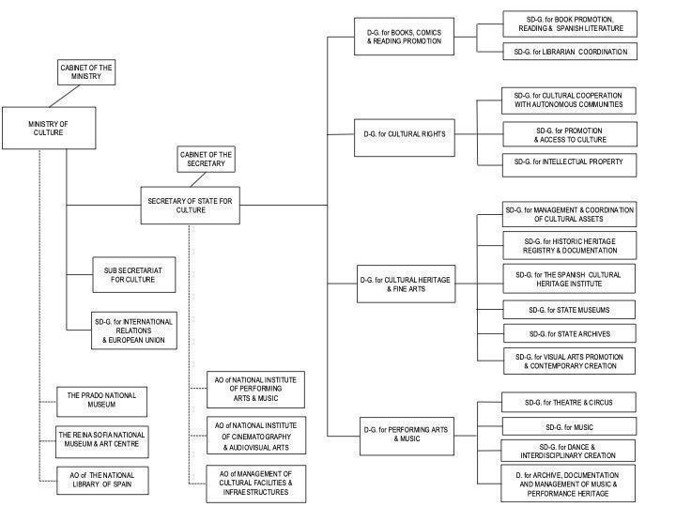 istry of Culture and Sport
DG: Directorate-General
SD-G: Sub Directorate-General
AO: Autonomous Organisation (self-governing public bodies dependent on the Ministry, in which its director has the rank of General Director)
Regional Level - Autonomous Communities
|
AUTONOMOUS GOVERNMENT |
DEPARTMENT |
VICE DEPARTMENT |
DIRECTORATES |
|
Culture and Sport |
Vice Department for Culture and Sport |
General Secretariat for of Cultural Innovation and Museums General Secretariat for Cultural and Documental Heritage General Secretariat for Sport D-G. for Museums and Cultural Compounds D-G. for Innovation and Cultural Promotion D-G. for Cultural Heritage D-G. for Sport Systems and Values D-G. for Events and Sportive Installations
|
|
|
Presidency, Justice and Culture |
|
D-G. for Culture and Cultural Heritage
|
|
|
Culture, Linguistic Policy and Sport |
|
Secretariat for Technical Affairs D-G. Cultural Action and Linguistic Normalisation D-G. for Cultural Heritage D-G. for Physical Activity and Sport
|
|
|
Tourism, Culture and Sports |
|
General Secretariat Autonomic Secretariat for Culture and Sports Consortium School of Hospitality of the Balearic Islands Balearic Studies Institute Balearic Islands Institute for Cultural Industries Balearic Islands Symphonic Orchestra Foundation D-G. for Tourism Balearic Islands Strategic Tourism Agency Foundation for Balearic Sport Robert Graves Foundation |
|
|
Universities, Science and Innovation, and Culture |
Vice Department of Universities and Research Vice Department of Culture and Cultural Heritage |
Secretariat for Technical Affairs D-G. for Universities and Research D-G. for Cultural Innovation and Creative Industries D-G. for Culture and Cultural Heritage Canarian Agency of Research, Innovation and Information Society |
|
|
Universities, Equality, Culture, and Sport |
|
General Secretariat for Culture, Tourism and Sport D-G. for Culture and Historic Heritage D-G. for Tourism and Hospitality D-G. for Sport |
|
|
Culture, Tourism and Sport |
Vice Department of Cultural Action |
General Secretariat D-G. for Cultural Heritage D-G. for Tourism D-G. for Sports |
|
|
Education, Culture and Sports |
Vice Department of Education, Universities and Research Vice Department of Culture and Sport |
Cabinet Office General Secretariat for Education Culture and Sports D-G. for Human Resources D-G. for Inclusive Education and Programmes D-G. for Professional Training D-G for Universities, Research and Innovation D-G. for Educational Innovation and Centres D-G. for Youth and Sports |
|
|
Culture |
|
Cabinet Office General Secretariat for Culture D-G. for Cultural Rights, Creation and Libraries Catalan Literature Institution Catalan Institute for Cultural Enterprises National Council for Culture and the Arts |
|
|
Education, Culture and Youth |
|
D-G. for Education D-G. for Cultural Heritage |
|
|
Education, Culture and Universities |
|
Cabinet Office Autonomic Secretariat for Education Autonomic Secretariat for Culture Autonomic Secretariat for Universities Sub-Secretariat D-G. for Teaching Staff D-G. for Teaching Centres D-G. for Educational Ordinance D-G. for Innovation and Inclusive Education D-G. for Culture D-G. for Universities D-G. for Science and Research D-G. for Education Infrastructure |
|
|
Culture, Tourism and Sports |
|
General Secretariat D-G. for Tourism D-G. for Sports |
|
|
Culture, Language and Youth |
|
Secretariat for Technical Affairs General Secretariat for Language D-G. for Culture D-G. for Cultural Heritage D-G. for Youth |
|
|
Culture, Tourism, Sport and Youth |
|
Secretariat for Technical Affairs D-G. for Tourism and Territorial Promotion D-G. for Sport and Youth Riojan Institute for Youth Institute for Riojan Studies |
|
|
Culture, Tourism and Sport |
Vice Department of Culture, Tourism and Sport |
Secretariat for Technical Affairs D-G. for Cultural Heritage and the Spanish Language Office D-G. for Culture and Creative Industries D-G. for Tourism and Hospitality D-G. for Sport |
|
|
Culture, Cultural Heritage and the Elder |
|
Technical Secretariat for Culture, Heritage and the Elder D-G. for Culture and Festivities D-G. for Cultural Heritage |
|
|
Tourism, Culture, Youth and Sport |
|
General Secretariat for Tourism, Culture, Youth and Sport D-G. for Cultural Heritage D-G. for Youth D-G. for Sports Institute for Tourism in the Region of Murcia Institute for Cultural Industries and Arts in the Region of Murcia |
|
|
Culture, Sport and Tourism |
|
Secretariat for Technical Affairs D-G. for Culture - Príncipe de Viana Institution D-G. Tourism Navarrean Institute for Sport and Physical Activity |
|
|
Cultural and Linguistic Policy |
Vice Department of Culture Vice Department of Linguistic Policy |
Directorate for Cabinet and Social Media Communications Directorate for Services Directorate for Physical Activity and Sport Directorate for Cultural Heritage, Intellectual Property and Legal Deposit Directorate for Linguistic Normalisation of Public Administrations Directorate for Euskera Promotion Directorate for Linguistic Research and Coordination |
Source: Autonomous governments official websites (2026)
*Cities with autonomous status
Last update: September, 2026
The 1978 Constitution created a new administrative territorial division in Spain, with three administrative levels: central government, Autonomous Communities or Regions and local councils (municipalities and provinces). According to the areas of competence laid down in the Constitution, all three levels have general responsibilities for culture, although the majority of public cultural expenditure comes from regional and local governments, which together represented 83.5% of public cultural spending in 2023 (see chapter 5.1).
The central government holds the exclusive responsibility for protecting cultural property against export, creating legislation to protect copyright, overseeing the basic rules on freedom of expression, creation and communication and regulating the means of communication (radio, television and the press) solely to the extent that such freedoms are threatened. At the same time, it retains the ownership of certain major cultural institutions, such as some museums, archives and libraries, even if their administration is sometimes delegated to the regions.
In November 2025, a new structure of the Ministry of Culture was established (Royal Decree 1028/2025) with four Directorates General:
- Directorate-General for Books, Comics and Reading Promotion
- Directorate-General for Cultural Rights
- Directorate-General for Cultural Heritage and Fine Arts
- Directorate-General for Performing Arts and Music
This lean organisational structure is partly explained by the existence of autonomous cultural bodies with independent legal status (public law entities) and a certain degree of operational autonomy. This is the case, for example, of the Prado Museum, the National Library of Spain, and the Institute of Cinematography and Audiovisual Arts.
Last update: September, 2026
At the regional level, Spain is divided into seventeen Autonomous Communities (and two cities with autonomous status), which exercise broad powers in cultural matters. The Constitution grants them both executive and regulatory authority in areas traditionally subject to public intervention, such as museums, libraries, the performing arts, and crafts. National museums, libraries, and archives remain under state ownership; however, in most cases, their day-to-day management has been delegated to the Autonomous Communities.
The involvement of regional governments in cultural affairs has traditionally been greater in those communities with their own language and in the so-called “historic nationalities”, that is, those that first obtained administrative autonomy: Andalusia, the Basque Country, Catalonia, and Galicia (Article 151 of the 1978 Spanish Constitution). At present, only Catalonia has assigned responsibility for cultural affairs to a dedicated department, while the remaining regional governments have opted for mixed structures in which culture is administered jointly with education, tourism, language policy, innovation, and/or sports.
The regions have played an active role in preserving heritage and developing cultural infrastructure. In those regions with their own language, cultural policies often focus on strengthening regional identity, particularly through statutory initiatives aimed at promoting and protecting these languages.
Similar to the national level, regional cultural administrations tend to have relatively lightweight structures. The coexistence of central administrative units and autonomous agencies is also common, with various regions incorporating autonomous bodies within their departmental frameworks, for example:
- Regional policy on reading and literature promotion in Catalonia is entrusted to an autonomous public body, the Institució de les Lletres Catalanes (Institute of Catalan Literature).
- In Andalusia, the management of cultural programmes is delegated to the Andalusian Agency for Cultural Institutions, an entity governed by public law.
- In Galicia, the Galician Centre of Contemporary Art operates as a key public institution in the field of contemporary culture.
- In the Region of Murcia, policies for the promotion, development, protection, and dissemination of the arts and cultural industries are entrusted to the Institute for Cultural Industries and the Arts.
- In the Valencian Community, the Valencian Institute of Culture is the public body responsible for implementing the regional government’s cultural policies, particularly in the fields of the performing arts, music, audiovisual sectors, and cultural heritage.
Last update: September, 2026
At the local level, the Local Regime Act 1985 gave city and town councils administrative powers over local heritage, cultural activities and amenities, and "leisure activities". The law states that population centres of over 5 000 inhabitants are obliged to provide library services, and it allows the municipalities to promote "complementary activities to those provided by other government bodies and, in particular, those concerning culture". In practice, local authorities have almost unlimited power to promote cultural activities at the municipal level. Their proximity to the citizens and the political rewards of such activities explain the huge expansion of local cultural events up to the start of the 1990s. Today, the bulk of public cultural spending (over 60%) is carried out at the local level.
A distinction should be drawn between the bigger cities (Madrid, Barcelona, Valencia, Valladolid, Bilbao, Sevilla, Oviedo, Salamanca, La Coruña, Santiago de Compostela), capable of funding major projects and activities, and the medium-sized and smaller towns, which only provide the basics (libraries) and support patron-saint festivals and other strictly local events.
Last update: September, 2026
A key actor in the provision of cultural services is the non-profit sector, often linked to large financial or industrial corporations. The 2008 financial crisis significantly altered private-sector funding for culture, as many Cajas de Ahorro (savings banks) ceased to operate. Nevertheless, institutions such as Fundación “la Caixa”, Fundación BBVA, Fundación Mapfre, and Fundación Ramón Areces continue to implement funding programmes to support cultural activities and, in some cases, manage their own cultural centres.
There are currently eight collective management organisations authorised by the Spanish Ministry to manage usage and related rights on behalf of, and in the interest of, authors and other intellectual property rights holders: the Spanish Society of Authors, Composers and Publishers (SGAE); the Spanish Reproduction Rights Centre (CEDRO); the Association for the Management of Intellectual Property Rights (AGEDI); the Artists and Performers Society of Spain (AIE); the Visual Management Entity of Plastic Artists (VEGAP); the Audiovisual Producers' Rights Management Association (EGEDA); the Artists and Performers Management Society (AISGE); and the Audiovisual Authors’ Rights Management Entity (DAMA).
In 2024, entities managing intellectual property rights collected 630 million euros, of which 420 million euros were distributed to rights holders. The main rights management entities were SGAE (58.5%), AIE (15.1%), and VEGAP (1.6%). Rights organisations had a total of 244,027 members, with significant differences in gender representation and organisational distribution.
Professional organisations play a key role in promoting the cultural and creative industries and in safeguarding authors’ rights. In recent years, several organisations have been active in advocating for artistic and cultural rights, including:
- the Spanish Federation of Associations of Cultural Managers, founded in 1999, represents cultural management professionals through a network of regional associations. It aims to strengthen the profession, foster knowledge exchange, and contribute to the development of cultural policies in Spain. The federation has also promoted collective advocacy initiatives, including the Pacts for Culture of 2010 and 2015;
- the Spanish Association of Women Filmmakers and Audiovisual Media Professionals, founded in 2006, works to promote the equal participation of women in the audiovisual sector;
- the Coalition of Creators and Content Industries, founded in 2008, is an umbrella organisation representing authors, performers and cultural industries. It advocates for the protection of intellectual property rights and supports measures to combat copyright infringement and online piracy in digital environments.
Last update: September, 2026
To foster a cross-cutting approach within the cultural field, a number of collegiate bodies have been established through which different levels of public administration—as well as different departments within the same level—cooperate.
Traditional inter-ministerial cooperation initiatives include the “1% Cultural Programme”, funded through allocations from major public works, whereby a minimum percentage of infrastructure investment (originally 1%, later raised to 1.5% and currently set up to 2% under updated regulations since 2021) is reserved for the conservation, restoration, and enhancement of Spanish cultural heritage, as well as for supporting artistic creation, under the framework of the Spanish Historical Heritage Act (Act 16/1985). The programme is jointly coordinated between the Ministry of Culture and the state infrastructure ministry (currently the Ministry of Transport and Sustainable Mobility, with participation from the Ministry of Housing and Urban Agenda where relevant), through inter-ministerial mechanisms that support the identification, selection, and financing of heritage-related interventions linked to public investment projects.
There are also numerous and diverse inter‑ministerial bodies and initiatives. For example:
- The Ministries of Culture and Labour have promoted a ‘Social Economy Agenda for Culture’, aimed at strengthening cultural cooperatives and worker‑owned companies.
- The Ministries of Culture and the Interior have reached an agreement to promote culture as a tool for intervention within the prison system.
- The Ministry of Culture and Correos have signed an agreement to support local independent bookshops, with the aim of improving their competitiveness by boosting online sales and expanding distribution networks.
In terms of intergovernmental co-operation, the State is constitutionally mandated to promote cultural communication among the different regions “in collaboration with them.” To this end, the central government has established a dedicated unit, currently titled the Sub-Directorate General for Cultural Cooperation with the Autonomous Communities, within the Directorate-General for Cultural Rights of the Ministry of Culture. The unit’s tasks include cooperating with the regions on their cultural programmes; fostering interregional communication in this field; promoting awareness of the richness and diversity of regional cultural heritage; and facilitating the exchange of information on cultural policies. It is also responsible for ensuring that the cultural diversity of Spain’s regions is promoted internationally, a task carried out in cooperation with the Ministry of Foreign Affairs, European Union and Cooperation, as well as Spanish embassies and consulates worldwide.
In practice, the mechanisms for coordinating central and regional government activities in cultural matters have operated with varying degrees of effectiveness. The Plenary Session of the Sectoral Conference on Culture met once during the third legislature (1986–1989), twice during both the fourth (1989–1993) and fifth (1993–1996) legislatures, and did not meet during the sixth and seventh legislatures (1996–2004). It met eight times during the eighth legislature (2004–2008), nine times during the ninth legislature (2008–2011), and seven times during the tenth legislature (December 2011–December 2015). The Plenary Session did not meet during the eleventh legislature (December 2015–July 2016), met once during the twelfth (July 2016–June 2018) and thirteenth (June 2018–November 2019) legislatures, and six times during both the fourteenth (December 2019–July 2023) and the current fifteenth legislature (August 2023–present). The latest Sectoral Conference took place in April 2026, during which a transfer of 14.5 million euros was approved for all Autonomous Communities, as well as Ceuta and Melilla.
Recovering and preserving national heritage is the area in which coordinated action by different levels of government has proven most effective. Since the early 1990s, there has been a proliferation of cooperation agreements across levels of government, particularly in relation to major urban development projects linked to the construction or rehabilitation of emblematic cultural sites. One illustrative example is the Council of St. James, established in 2001 as a cooperation body to facilitate coordination between the central administration and the participating Autonomous Communities (Aragon, Asturias, the Basque Country, Cantabria, Castile and León, Catalonia, Galicia, La Rioja, and Navarre).
Beyond the heritage field, and within the framework of the Sectoral Conference of Culture, several working groups have been created, bringing together representatives of the central administration and the Autonomous Communities. These groups aim to promote communication and cooperation in a range of areas, including cinematography and audiovisual policy, video games, musical heritage, and other cultural domains.
As for relations among the regions themselves, the level of information and technical exchange is extremely low, with the exception of the historic communities. Collaboration between Catalonia and the Basque Country has materialised over the years in numerous projects and the exchange of information and experiences on their cultural policies. In recent years, the Departments of Culture of these communities, together with Occitanie Pyrénées–Méditerranée, have collaborated within the ARTIS+ programme, which aims to improve inclusion and accessibility in cultural facilities across the cross‑border area through initiatives targeting groups at higher risk of exclusion due to disability or social factors.
Similarly, very little progress has been made in inter-regional and national-regional co-ordination to project Spanish culture internationally. The notable exception has been the Ramon Llull Institute, a public body to promote Catalan language and culture abroad.
In terms of cooperation at the municipal level, aside from the above-mentioned examples involving central and regional government and the councils of certain cities, mention should also be made of the assistance provided by certain regional governments for local townships. For example, the Island Councils of the Canaries and the Provincial Councils of some regions, mainly the Basque Country and Catalonia, have contributed to the development of inter-municipal cultural activities through museums, libraries, archives and local theatre tours. Municipal culture departments have also worked together with their colleagues responsible for urban development, education or tourism.
Since the Agenda 21 for Culture was approved on 8 May 2004, a growing number of Spanish cities and municipalities have adopted it at local government level. To promote the principles enshrined in the document, the United Cities and Local Governments established a Working Group on Culture, which is chaired by the Councillor for Culture of the Barcelona City Council. The Spanish Federation of Municipalities and Provinces also has a Commission on Culture to provide local governments with useful planning and evaluation tools.
Last update: September, 2026
Spain’s leading cultural institutions can be divided into three groups depending on their origins: national institutions, institutions set up by civil society, and institutions that emerged during the period of restored democracy. National institutions have been linked to the central government from the outset, and most of them are in Madrid (Prado Museum, Royal Theatre, National Library of Spain, etc.). The second type can usually be traced to the cultural aspirations of the cultural elites at specific moments in history, particularly in those cities having a strong industrial base, for example, Barcelona, Bilbao, Oviedo, etc. Lastly, there are numerous public initiatives undertaken over the last 30 years by various levels of government, such as the construction of several major cultural spaces, the majority outside Madrid, thereby promoting cultural decentralisation. Some of those cultural facilities, promoted before the deep financial crisis without any feasibility study, remain inconclusive or without cultural activity.
National institutions depend nearly entirely on the central government for funding, although boards of governors are allowed considerable leeway in decision-making. A significant number of the other cultural institutions in the country are financed and self-managed under agreements between different levels of government. This inter-institutional co-operation seeks to promote coherence in regional development strategies and, indirectly, encourages greater self-management in the day-to-day running of the institutions.
Last update: September, 2026
Data on cultural institutions have been taken from the Cultural Statistics Yearbook published by the Ministry of Culture. Although it was not always possible to distinguish between public and private ownership, as shown in Table 1, the general trend in recent years has been an increase in cultural institutions. The most significant growth occurred in concert venues, which increased by 150.5% between 2019 and 2024 (from 541 to 1 355). This was followed by film festivals and dance festivals, which grew by 66.7% (from 36 to 60) and 60.8% (from 390 to 627), respectively, over the same period. Growth was also observed in music schools, academies and universities, which increased by 36.2% (from 1 446 to 1 996).
At the lower extreme, libraries experienced a decrease of 14% between 2019 and 2024.
Table 1: Cultural institutions financed by public authorities, by domain, 2019-2024
|
Domain |
Arts and heritage institutions (subdomains) |
Number (year) |
Trend last 5 years (%) |
|
Cultural heritage |
Cultural heritage sites (recognized) |
17 199 (2019) 18 537 (2024) |
7.8% |
|
|
Museums (organisations) |
1 461 (2018) 1 506 (2024) |
3.1% |
|
|
Archives (of public authorities) |
35 (2019) 37 (2024) |
5.7% |
|
Visual arts |
Public art galleries / exhibition halls |
na |
na |
|
|
Art academies (or universities) |
na |
na |
|
Performing arts |
Symphonic orchestras, choirs, bands, etc. |
4 663 (2019) 5 286 (2024) |
13.4% |
|
|
Music festivals and other activities |
1 567 (2019) 1 508 (2024) |
-3.8% |
|
|
Music schools, academies and universities |
1 466 (2019) 1 996 (2024) |
36.2% |
|
|
Concert houses |
541 (2019) 1355 (2024) |
150.5% |
|
|
Stable theatre spaces |
1709 (2019) 1786 (2024) |
4.5% |
|
|
Theatre companies |
4252 (2019) 4721 (2024) |
11% |
|
|
Theatre festivals |
776 (2019) 916 (2024) |
18% |
|
|
Dance and ballet companies |
917 (2019) 1170 (2024) |
27.6% |
|
|
Dance festivals |
390 (2019) 627 (2024) |
60.8% |
|
|
Dance academies |
791 (2019) 1071 (2024) |
35.4% |
|
Books and Libraries |
Libraries |
6458 (2018) 5552 (2024) |
-14% |
|
|
Publishers |
3170 (2019) 3158 (2024) |
-0.4% |
|
Audiovisual |
Broadcasting organisations |
na |
Na |
|
|
Cinemas |
4459 (2019) 4300 (2024) |
-3.6% |
|
|
Film production companies |
381 (2019) 561 (2024) |
47.2% |
|
|
Film distribution companies |
293 (2019) 317 (2024) |
8.2% |
|
|
Film festivals |
36 (2019) 60 (2024) |
66.7% |
|
Interdisciplinary |
Socio-cultural centres / cultural houses |
na |
Na |
|
Other (please explain) |
Bullfighting festivals |
1425 (2019) 1457 (2024) |
2.2% |
Source: Ministry of Culture (several years) Cultural Statistics Yearbook.
Note: na means data not available.
Last update: September, 2026
In recent years, the outsourcing of public services has extended to the governance and management of cultural organisations. The management of both new and existing cultural services, previously under direct governmental control, has progressively been delegated to external companies and organisations. This trend forms part of a broader shift towards the externalisation of public services.
In the cultural sector, this process initially involved the creation of public contractors—such as public cultural foundations, committees and specialised public companies—to streamline administrative procedures and increase flexibility in subcontracting and income management. At the same time, secondary services with limited cultural impact—including catering, security, cleaning and commercial activities—were widely outsourced. Over time, factors such as constraints on public staffing, the demand for specialised services at competitive costs, and the weakening of traditional links between public ownership and public management have encouraged the outsourcing of an increasing number of functions within cultural administration.
In a first phase, publicly owned cultural institutions outsourced support services with significant cultural content, such as educational and mediation activities, which are now commonly provided by external operators in museums and exhibition centres. Subsequently, the process has expanded to include the full transfer of management responsibilities. Today, outsourcing extends to a wide range of facilities, including community centres, municipal arts centres, galleries, exhibition halls, archaeological sites, concert halls, theatres and, in some cases, museums.
At the same time, various national and regional institutions have reformed the procedures for appointing directors, with the aim of improving transparency, professionalism and objectivity. At the central level, initiatives first implemented at the Prado Museum were later extended to other leading institutions, such as the Reina Sofía National Museum and Art Centre and the National Library of Spain.
These reforms were initially promoted within the framework of the Cultural Institutions Modernisation Plan (approved in September 2007) and were subsequently reinforced through the General Strategic Plan 2012–2015 of the State Secretariat for Culture. Together, these initiatives sought to increase the managerial autonomy of major cultural institutions while enhancing their financial sustainability through expanded public–private collaboration. Notably, institutions such as the Prado Museum and the Reina Sofía National Museum and Art Centre have been granted a special status that allows them, within Spain’s legal framework, to operate under certain private-law arrangements.
In this context, sponsorship and fundraising—closely linked to greater institutional autonomy—have encouraged stronger collaboration with the private sector and enabled cultural institutions to adopt more innovative management practices[1]. A representative example is the Barcelona Museum of Contemporary Art (MACBA).
More recently, forms of civic engagement such as volunteerism have become increasingly prominent across cultural institutions. Initiatives such as Friends of Museums associations, grouped within the Spanish Federation of Friends of Museums (established in 1983), have contributed to strengthening connections between institutions and society. Similar initiatives include the Foundation of Friends of the National Library (established in 2009) and the Foundation of Friends of the Prado Museum, which has more than 21,000 members. In addition, the Prado Museum’s patron programme currently accounts for approximately 30% of its internal funding.
[1] For more details, see: Rubio-Arostegui, J. A., & Villarroya, A. (2022). Patronage as a way out of crisis? the case of major cultural institutions in Spain. Cultural Trends, 31(4), 372–391. https://doi.org/10.1080/09548963.2021.1986670
Last update: September, 2026
The promotion of Spanish culture abroad is a joint endeavour between the Ministry of Culture and the Ministry of Foreign Affairs, European Union and Cooperation. Within the Ministry of Culture, the Subdirectorate‑General for International Relations and the European Union is responsible for coordination, management, and advisory functions in the field of international cultural relations and technical cooperation.
The Ministry of Foreign Affairs, European Union and Cooperation is responsible for Spain’s external cultural action through its State Secretariat for International Development Cooperation and for Ibero‑America, the Caribbean and Spanish in the World. Within this framework, the Spanish Agency for International Co-operation and Development (AECID) oversees cultural and scientific exchanges, including grants and scholarships, and manages Spain’s international commitments in these areas. AECID operates through Spanish embassies and consulates, as well as through its network of cultural centres abroad.
The Cervantes Institute, established in 1991 as an autonomous public body under the Ministry of Foreign Affairs, is responsible for promoting the Spanish language and culture internationally. It operates through a network of 100 centres in 54 countries.
The Spanish Public Agency for Cultural Action (AC/E), established in 2010, promotes and disseminates Spanish culture both domestically and internationally, supports joint initiatives involving regional and national cultural institutions, and fosters the international presence of artists, scientists and cultural and creative industries. Since 2013, it has implemented the Programme for the Internationalisation of Spanish Culture (PICE).
The governance of Spain’s external cultural policy has traditionally involved a degree of institutional overlap between the Ministry of Culture and the Ministry of Foreign Affairs. This was addressed in July 2009 through an agreement to establish the National Plan for Cultural Action Abroad (PACE), aimed at improving coordination.
At present, the Subdirectorate‑General for International Relations and the European Union is responsible for drafting and coordinating the Ministry of Culture’s international strategy and for promoting Spanish culture abroad, in coordination with the Ministry of Foreign Affairs and the relevant policy departments.
At the end of 2024, the Ministry of Culture outlined the main priorities of its forthcoming Strategic Plan for External Cultural Action (2025–2028). The Plan aims to strengthen the international projection of Spanish culture and heritage by promoting cultural rights as a global public good, reinforcing cultural diplomacy as a tool for peace, and supporting the internationalisation of the cultural and creative industries.
Cultural activities abroad are also supported by a range of public and semi-public institutions, including:
- the Carolina Foundation (established in 2000), which promotes cultural and academic exchanges—particularly with the Ibero‑American community—through grants, research and mobility programmes;
- Casa de América (Madrid, established in 1990), which fosters dialogue and cooperation between Spain and Latin America;
- the Euro-Arab Foundation for Higher Studies (Granada, established in 1995), which promotes cooperation between the European Union and the League of Arab States;
- the European Institute of the Mediterranean (established in 1989), which supports cooperation initiatives and promotes institutional relations in the Mediterranean area;
- Casa Asia (Barcelona, established in 2001; Madrid office opened in 2007), which promotes relations between Spain and countries in Asia and the Pacific across institutional, economic, academic and cultural fields;
- Casa África (Las Palmas, established in 2006), which fosters dialogue and cooperation between Spain and African partners;
- Casa Árabe (established in 2006, with centres in Madrid and Córdoba), which promotes knowledge and engagement with Arab and Muslim countries;
- Casa Sefarad-Israel (established in 2006), which promotes knowledge of Jewish culture and relations between Spanish and Israeli societies;
- Casa Mediterráneo (established in 2009), which serves as a platform for dialogue and cultural exchange in the Mediterranean region.
From a budgetary perspective, state policy for cultural promotion abroad is mainly implemented through the programme Cultural Diffusion Abroad. In 2024, this programme amounted to 153 047 000 euro, representing 11% of total public cultural expenditure. Since 2020, funding has increased by 37%.
Recent initiatives include Mostra Espanha 2026 (a biennial festival of Spanish culture in Portugal), España–Portugal: 50 años de democracia, and Cultura para la Paz – España–Palestina (developed in collaboration with the Palestinian Embassy in Spain).
The international promotion of cultural industries includes Spain’s participation as a guest country at book fairs in Latin America, as well as its role as guest of honour at the Angoulême International Comics Festival (France) in 2025. Spain was also the “Focus Country” at the Berlinale in 2025 and participated in the Cannes Film Market and the Toronto International Film Festival (TIFF).
In 2026, the Ministry of Culture signed two Memoranda of Understanding with Brazil to promote cooperation in the ecological transition of cultural and heritage institutions, cultural rights, the protection of cultural workers and the development of cultural industries. These agreements were announced at the first Spain–Brazil Summit in Barcelona.
At the regional level, autonomous communities have expanded their international cultural activities in recent years. Early initiatives include the Catalan Consortium for the External Promotion of Culture (established in 1992, now integrated into the Catalan Institute of Cultural Enterprises) and the Etxepare Basque Institute (established in 2007).
More broadly, regions with strong diasporic ties, such as Galicia, promote cultural exchanges, particularly in music and dance. Border regions engage in cross-border cooperation within European Union frameworks, while Andalusia prioritises cultural relations with Morocco. Increasingly, regional governments use cultural diplomacy as a strategic tool to support trade and tourism.
Last update: September, 2026
Spain has been a member of the European Union since 1986. Within this framework, the Subdirectorate‑General for International Relations and the European Union performs key coordination functions, including the monitoring of the Ministry of Culture’s activities related to the European Union and other international organisations in the field of culture; participation in the preparation of international treaties, conventions and cooperation programmes; and the provision of advisory services regarding Spain’s involvement in international cultural organisations.
Spain actively participates in major European Union funding programmes, including Creative Europe and Horizon Europe (2021–2027), as well as Erasmus+ and other cooperation initiatives that promote cultural exchange, mobility and innovation. Spain also participates in the EEA and Norway Grants mechanisms, particularly in areas related to cultural and natural heritage, social inclusion, and cultural diversity.
With regard to the Council of Europe, of which Spain has been a member since 1977, the Subdirectorate‑General for International Cooperation, in coordination with the Ministry of Foreign Affairs, European Union and Cooperation, is responsible for coordinating and supporting Spain’s participation in Council activities. Spain joined the Faro Convention in December 2018.
Spanish institutions participate in around 30 certified Cultural Routes of the Council of Europe, including the Ways of Santiago de Compostela, the European Routes of Jewish Heritage, the European Route of Industrial Heritage, Iter Vitis, and the Routes of the Olive Tree, among others.
Spain’s cultural cooperation with UNESCO, of which it has been a member since 1953, involves coordination and representation functions, including liaison between national authorities and UNESCO bodies, participation in intergovernmental processes, and cooperation with the Spanish National Commission for UNESCO.
The Ministry of Culture is responsible for implementing the UNESCO Convention on the Protection and Promotion of the Diversity of Cultural Expressions, ratified by Spain in December 2006. Reflecting this commitment, Spain was selected to host MONDIACULT 2025.
Within the Organisation of Ibero-American States for Education, Science and Culture (OEI), of which Spain has been a member since 1949, the Ministry of Culture coordinates participation in the Ibero-American Conferences of Ministers of Culture.
Cooperation with the OEI is structured through sectoral programmes, including: ABINIA, IBERARCHIVOS-ADAI and RILVI (archives and libraries); IBERMEDIA (audiovisual sector); IBERMÚSICAS and IBERORQUESTAS JUVENILES (music); IBERMUSEOS (heritage and museums); FIPI (intellectual property); IBERESCENA (performing arts); and IBERBIBLIOTECAS (libraries).
Spain is also a signatory to the Andrés Bello Agreement (since 1982), which promotes cooperation in education, science and culture across Ibero-America. In addition, Spain is a member of (CERLALC), an intergovernmental organisation affiliated with UNESCO that supports reading and publishing policies in Latin America and the Caribbean.
Last update: September, 2026
Over the past decade, partly as a result of the increasing professionalisation of the cultural sector and the impact of successive economic crises on public finances in Spain, cultural institutions have strengthened their engagement with international cooperation networks. In the European context, they have also expanded their participation in collaborative projects funded through EU programmes, particularly Creative Europe, Horizon and Erasmus+, which support a wide range of transnational cultural initiatives.
Spain maintains a strong presence in European and international cooperation networks across culture, heritage, museums, libraries and the arts. Spanish institutions and professionals participate in organisations such as the Network of European Museum Organisations (NEMO), the European Concert Hall Organisation (ECHO), the European Festivals Association (EFA), Eurozine, the European Network for Opera, Music Theatre and Dance Education (RESEO), the European Network on Cultural Management and Policy (ENCATC), and the European Bureau of Library, Information and Documentation Associations (EBLIDA). This engagement extends to pan-European platforms such as Europa Nostra and Culture Action Europe, as well as to digital and heritage infrastructures such as Europeana.
At the institutional level, the Reina Sofía National Museum and Art Centre (MNCARS) provides a representative example of innovative museum practice through its engagement with non-conventional and transnational networks. Initiatives such as Red Conceptualismos del Sur promote decentralised approaches to heritage through shared archival practices, while collaborations with the Fundación de los Comunes contribute to the development of participatory and experimental models of cultural governance. Within the European context, MNCARS is a member of L’Internationale, a transnational museum network that promotes decentralised and non-hierarchical collaboration based on horizontal exchange and cultural diversity, in close connection with academic and research institutions.
More broadly, Spanish cultural institutions increasingly engage in European initiatives focused on cultural democracy, digital heritage and collaborative innovation. These initiatives—often supported by EU programmes—emphasise participatory governance, audience engagement and cross-sectoral cooperation. In the performing arts, transnational networks continue to support mobility and intercultural dialogue, reflecting broader trends towards increasingly collaborative and internationally connected cultural ecosystems.