
1. Cultural policy system
Poland
Last update: July, 2026
The contemporary cultural policy of the Republic of Poland is an intentional and systematic intervention of central and local governments in the field of culture and its industries. Cultural policy is based on the welfare state model and combines the state’s responsibility for fostering cultural development and preserving national heritage with market reality, digital transformation and the growing importance of creative industries, technological innovation and sustainable development. It can be characterised by a high degree of decentralisation, in which a substantial amount of responsibility for supporting and financing culture lies with local authorities. The whole system provides a guarantee for a relatively stable operation of a high number of public cultural institutions.
Both the goals and principles of the cultural policy in Poland are formulated in accordance with standards established by democratic European states. As the other EU member states, Poland is free to develop cultural policies in its own way, without the unification of cultural institutions, setting their own goals and determining priorities. Poland implements this autonomy to the full extent, which can be especially observed in case of assigning new priorities to cultural policies, whose characteristics are strongly determined by the political programme of a ruling party in a given period.
The current goals of Polish cultural policy are:
- Preservation of national and cultural identity;
- Assurance of equal access to culture;
- Promotion of creative output and high-quality cultural goods and services;
- Diversification of cultural offer, taking into account the variety of social groups;
- Strengthening the social and economic sustainability of artistic and cultural work;
- Supporting digital transformation, media literacy and innovation in the cultural and creative sectors;
- Increasing territorial accessibility to culture and support for local cultural institutions;
- Strengthening international cultural cooperation, including within the framework of the European Union.
The current principles of Polish cultural policy:
- Decentralisation of decision-making processes regarding the organisation and financing of cultural activities;
- Fostering community participation in decision-making processes by organising expert panels and initiating public discussions regarding possible solutions for key problems;
- Ensuring the transparency of decision-making processes;
- Applying the principle of subsidiarity: decisions concerning culture are made by those, to whom they pertain. Central authorities cannot make decisions concerning local affairs instead of local governments, unless they have been specifically authorised to do so;
- Supporting evidence-based cultural policy through research, data collection and long-term strategic planning;
- Strengthening institutional pluralism and the autonomy of public cultural institutions.
Following the parliamentary elections of 15 October 2023 and the formation of Donald Tusk’s coalition government in December 2023, national cultural policy entered a period of institutional and strategic reorientation. The new government declared a shift toward rebuilding dialogue with the cultural sector, strengthening transparency in the governance of public institutions, supporting broader access to culture, improving social protection mechanisms for artists and creators, and developing a long-term strategic framework through work on the Strategy for Culture 2050. At the same time, the reform of public media governance, the implementation of copyright reforms related to the Digital Single Market Directive, the development of creative industries and debates concerning artificial intelligence, sustainability and cultural labour became central topics of contemporary cultural policy in Poland.
Background
We can identify two basic periods that characterise the development of Polish cultural policy in the last 75 years.
Both are directly linked to the political system implemented in Poland during each period, i.e., the period 1945-1989 was characterised by real socialism and the period from 1989 onwards is characterised by parliamentary democracy and a market economy.
Distinguishing features of the first period include limited sovereignty, a one-party system and a planned economy. Cultural activities were organised under a system characterised by a high level of centralisation, institutionalisation and a monopoly of state property. The decision-making process regarding the development of cultural activities was strongly politicised and the creative arts were subject to political censorship. The principles of cultural policy were created by both the Ministry of Culture and Arts, and the Cultural Division of the Central Committee of the PZPR (Polish Communist Party). At the same time, the growth rate of public cultural expenditure was higher than the growth rate of the GDP, which gave the state legitimacy to act in this field. The "Fund of Development for Culture" was established in 1982 as a means to secure this position. Between 1982 and 1989, expenditure on culture within the overall state budget rose from 1.25% to 1.81%. This relatively high level of public funding for culture enabled wider access to cultural goods and services and a feeling that professional stabilisation for artists’ working conditions was being achieved.
In the beginning of the second period – since 1989 – Poland has undergone a process of political and economic transformations, while the state re-established its new responsibilities of a social nature. Those responsibilities were formulated in the preamble to the Constitution of the Republic of Poland.
The major changes which have taken place in the cultural sector since 1989 revolve around the following principles:
The implementation of the right of freedom of artistic creation, education and use of cultural assets, as well as to conduct scientific research and announce their results, granted by the Constitution (1997).
The creation of a new legal framework, allowing to organise and conduct cultural activities within a market economy (Act on Organising and Conducting Cultural Activity of 25 October 1991, with later amendments and annexes; Act of Law on Associations of 7 April 1989, with later amendments and annexes; and a number of other legal solutions).
Changes in the public responsibilities for culture came in the wake of a more general process of decentralisation of state powers and the subsequent reform of several laws.
The decentralisation of power of the public administration concerning culture – transferring the majority of cultural institutions from the central government to local governments, operating at three levels: provincial (Voivodeship), district (Poviat) and municipal/communal (Gmina). The responsibility for local cultural activities and the establishment of local cultural institutions is shared between the provincial, district and municipal administrations.
The privatisation of the majority of cultural industries, previously owned by the central (socialist) state.
A true eruption of civic organisations in the cultural sector – in the 1990s, foundations and associations started to be formed. Although for many years non-governmental organisations were not treated as fully equal partners of the state and local governments in the field of culture, their role gradually increased after Poland’s accession to the European Union and further strengthened after 2023. The coalition government formed after the parliamentary elections of October 2023 declared a stronger emphasis on dialogue with civil society organisations, participatory governance and the inclusion of NGOs in strategic cultural policymaking, grant programmes and local cultural development.
In 2003-2004 efforts were made to prepare Poland for gaining access to EU funds, especially the EU’s Structural Funds. In this context, emphasis has been placed on developing regional approaches to the development of culture. The awareness of the significance of culture as a development factor is increasing in the face of dynamic socio-economic and technological transformations. Categories such as cultural industries and creative industries appear. The concept of the creative economy is being defined, in order to highlight the creative component in production, not only for symbolic goods, i.e. cultural goods. The scope of public funding has been expanded. Currently, it refers to the main cultural domains together with cultural and creative industries. This can be seen, for example, in the subsidy programs of the Ministry of Culture and National Heritage. In the 2020s, the role of cultural and creative industries expanded further in Polish cultural policy. Increasing attention has been devoted to digital transformation, video games, design, audiovisual production, fashion and innovation-oriented creative sectors. Public policies increasingly combine cultural goals with economic development, technological innovation, international competitiveness and sustainability.
Since 2018, after years of absence in both government policy and public debate, the topic of developing a support system for artists, creators and performers has been back on the agenda. Currently, government research-based work on a new law on professional artist rights is pending. It is worth noting the participatory nature, which means that artistic circles are broadly included in its development. In January 2026 the Ministry presented in the Sejm a draft act on social security for professional artists. The draft introduces the status of a professional artist and temporary co-financing of social and health insurance contributions for artists with low and irregular income.
Main features of the current cultural policy model (in the profile authors’ opinion)
After 1989, culture and its management in Poland underwent substantial changes, as already touched upon above. In the 1990s, the transformation from planned to market economy, as well as administrative reforms, have extorted a series of adaptation processes within the cultural sector, many of which could be described as radical in their nature. Even though those processes could not be considered as the result of strategic thinking regarding cultural development, but rather as by-products of the administrative changes that Poland had undergone, they still brought many positive effects.
On the one hand, cultural stakeholders, such as artists, creators, performers and producers or managers, engage freely in the discussion regarding innovative methods of cultural management, cross-sectoral partnerships or the economic importance of culture. They operate and create within various cultural fields and industries, expressing their passion through civic engagement and activities, applying new technologies and constantly developing the third sector in Poland. Drawing examples from international models, they actively search for and utilise diverse financial resources, including EU funding and private donations. On the other hand, the decentralisation of cultural administration allowed all levels of local governments to focus on strategic planning in the area of cultural development.
In the 2020s, the cultural policy model in Poland became increasingly shaped by issues related to digital transformation, sustainability, social security of artists, public media governance and the growing role of cultural and creative industries in economic development. Public debate concerning culture increasingly extends beyond traditional artistic fields and includes questions related to artificial intelligence, platform economies, copyright reform, media literacy and the regulation of digital environments.
The post-pandemic period also intensified discussions on structural precarity in the cultural sector, especially among freelance artists, creators and cultural workers operating within project-based and unstable employment systems. In response, public authorities initiated legislative work on new mechanisms of social and health insurance support for professional artists, while local governments and cultural institutions increasingly focused on resilience, accessibility and long-term institutional sustainability.
At the same time, tensions concerning the governance of public institutions and public media revealed the continuing political significance of culture in Poland. Debates regarding transparency, institutional autonomy, pluralism and participation became central elements of cultural policy discussions after the parliamentary elections of 2023.
Overall, Poland and its cultural sector have demonstrated a strong capacity to adapt to changing political, economic and technological conditions. Cultural institutions, NGOs, artists and creative entrepreneurs actively seek new organisational models, international partnerships and innovative forms of cultural participation. However, contemporary challenges increasingly concern not only adaptation to globalisation and economic crises, but also the long-term sustainability of cultural labour, digital transformation, demographic change, climate policy and the growing influence of artificial intelligence on cultural production and distribution.
When viewed from the perspective of 2026, many structural reforms in the cultural sector still remain incomplete. This concerns in particular the stability of cultural financing, the social protection of artists, public media governance, equal territorial access to culture and the creation of coherent long-term strategic frameworks for cultural development. At the same time, recent years brought a visible strengthening of evidence-based policymaking, strategic planning and broader participation of cultural stakeholders in public debate.
The rapid development of generative artificial intelligence has become one of the most important contemporary challenges for cultural policy and the cultural and creative sectors (CCS). Public institutions, academic centres and professional organisations increasingly debate the implications of AI for copyright, artistic labour, cultural production, education and creative autonomy. At the same time, cultural institutions and creative enterprises are gradually incorporating AI-based tools into their everyday operational and artistic practices, making digital transformation one of the defining characteristics of the contemporary Polish cultural policy landscape.
Last update: July, 2026
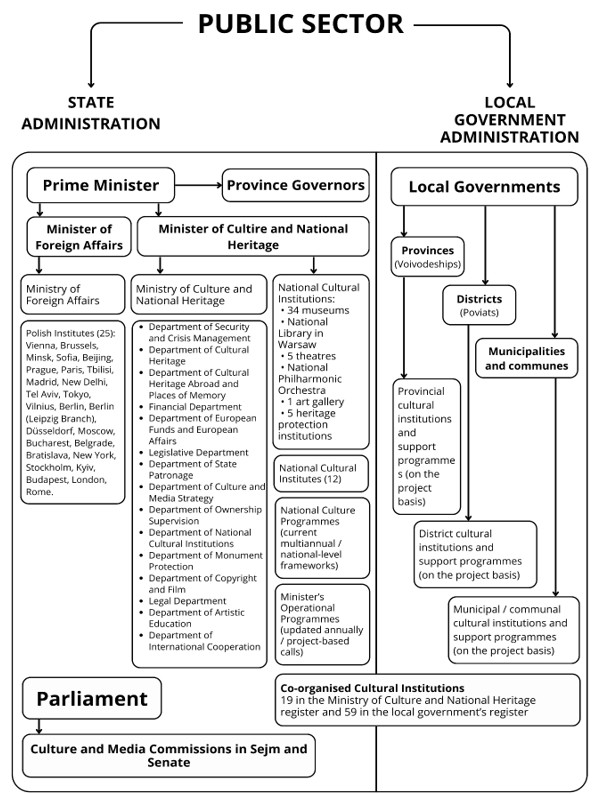
Last update: July, 2026
The central state administration is the main actor which sets cultural policy objectives and funding principles. The main policy-maker is the Minister of Culture and National Heritage. Nevertheless, other ministers also have the authority to establish cultural institutions (for example, the Polish Army Museum is subordinated to the Ministry of National Defence).
The main tasks of the Ministry of Culture and National Heritage include:
- The preparation of the draft state budget in part at the Minister's disposal;
- Taking care of the national fields of theatre, music, ballet, opera, stage art, fine arts, literature, museology, folk culture, cultural education, and the amateur art movement, and of the cultural exchange with foreign countries;
- Issuing opinions on draft legal acts and developing them in terms of formal and legal matters;
- The execution and coordination of the implementation of tasks resulting from government policy on the protection of monuments; Initiating activities to maintain and popularise the national and state traditions;
- The care and supervision of artistic education;
- Carrying out tasks in the field of audiovisual policy;
- Developing strategic cultural policy frameworks related to digital transformation, creative industries, sustainability and international cultural cooperation;
- Coordinating activities connected with copyright reform, artificial intelligence and social security mechanisms for artists and cultural professionals.
The Ministry of Culture and National Heritage includes the Minister's Political Cabinet and the 21 organisational units.
The Ministry of Culture and National Heritage is the founding body and co-owner (with local government units) of 81 cultural institutions. These institutions are located in all sixteen voivodeships (provinces) and consist of theatres, operas, philharmonics, orchestras, museums, as well as cultural and art centres. Among them are institutions of special importance for the Polish heritage, culture and art, such as the Grand Theatre, the National Opera, the National Museum and the National Library (see 1.3.3 for more information).
The Minister of Culture and National Heritage also appoints specific cultural institutions that support a given field of culture. These are, for example: the Institute of Music and Dance, the Book Institute, the Adam Mickiewicz Institute (responsible for the promotion of Polish culture abroad), the Zbigniew Raszewski Theatre Institute, the National Heritage Board of Poland and the Fryderyk Chopin Institute. These institutes conduct regranting and research activities, organise festivals and competitions, cooperate with different stakeholders and international partners, etc.
In recent years, the institutional system supporting culture has expanded to include stronger support for cultural and creative industries, digital transformation and international cultural promotion. The growing role of institutions such as the Institute of Creative Industries reflects the increasing importance of sectors including video games, design, fashion and audiovisual production in contemporary cultural policy.
The Minister's programmes are aimed at co-financing project-related tasks in the field of culture, excluding the permanent cultural activity of entities. These programmes are meant for cultural institutions, non-governmental organisations, film institutions, schools and universities, local government units, business entities, churches and religious associations. Natural persons are not entitled to submit applications, except for the Monument Protection programme.
In 2025 the Ministry announced reforms of the Minister’s Programmes, including clearer assessment criteria, simplified procedures and greater accessibility for smaller entities. In 2026, the Ministry planned 30 Ministerial Programmes with a total budget of PLN 562 million (EUR 132.24 million[1]), representing an increase of PLN 38 million (EUR 8.94 million). The programmes continued to cover heritage, books and reading, artistic fields, cultural education, infrastructure, international promotion and creative sectors.
Together with the Ministry of National Education and the Ministry of Science and Higher Education, the Ministry of Culture and National Heritage is responsible for arts education at all levels of education.
The Cultural Commissions that are located in two houses/chambers of the Parliament of the Republic of Poland (Sejm and Senat) are responsible for legislation in the field of culture. Their role is to:
- Propose candidates for positions in the state cultural policy administration;
- Amend, consider and present opinions for legalisation or legal acts;
- Consider reports and communications of the Minister of Culture;
- Analyse activities in the cultural field; and
- Prepare responses on budget related requests.
The Commission of Culture and Mass Media of the Sejm specifically deals with issues arising in the following fields: creativity, dissemination of culture, protection of cultural heritage, press, radio and television, publishing houses, socio-cultural movement and cultural co-operation on the international forum/foreign cultural cooperation.
[1] The amounts were converted using the National Bank of Poland exchange rate for April 2026, which was 4.25 PLN/EUR.
Last update: July, 2026
There are cultural administration bodies located at the voivodeship (regional), poviat (district) and municipal levels.
Each level of local government has a statutory obligation to undertake activities in the area of culture and the protection and care of monuments. The most important element of this obligation is the financing of local government cultural institutions and defining their own cultural policy.
In recent years, the role of local governments in cultural policy has become even more important due to the high level of decentralisation of the Polish cultural system. Local authorities increasingly shape not only the financing of culture, but also strategic priorities connected with accessibility, local identity, social inclusion, sustainability and digital transformation. Many municipalities and regions have developed their own cultural development strategies, often linked with broader social, educational and climate-related policies.
The catalog of initiatives implemented by local governments is wide, including:
- Carrying out tasks and projects supporting cultural phenomena, supporting creativity and cultural potentials, and promoting the culture and national heritage sector;
- Coordinating and organising cultural exchange in cooperation with domestic and foreign regions;
- Supporting tasks carried out by institutions and organisations of the cultural sector and entities acting for the protection of monuments;
- Organising various events, competitions (including grant and prize competitions) and projects;
- Supporting local cultural centres, NGOs and grassroots cultural initiatives;
- Implementing projects related to digital culture, media education and social participation;
- Developing sustainable cultural infrastructure and improving accessibility for people with disabilities and residents of smaller towns and rural areas.
The most common forms of financing culture by local government units include: subsidies; grants; material or financial assistance; granting patronage; organisation of competitions; public procurement; civic budgets; village council funds; and district funds.
After 2023 elections, increasing attention has also been devoted to transparent grant procedures, participatory budgeting and cooperation with civil society organisations. Local governments increasingly use European Union funds, including FEnIKS and National Recovery and Resilience Plan (KPO) resources, to modernise cultural infrastructure, improve energy efficiency and support the digital transformation of local cultural institutions. At the same time, local cultural policy in Poland continues to face important challenges related to financial inequalities between regions, rising operational costs of cultural institutions and uneven access to cultural services between large urban centres and peripheral areas.
Last update: July, 2026
Please find the available information on this subject in 1.2.3.
Last update: July, 2026
Although Poland does not have a fully developed QUANGO-type model in the field of culture, non-governmental organisations, professional associations and expert communities increasingly participate in cultural policymaking processes through consultations, advisory bodies, public debates and grant mechanisms. Their role became more visible after the parliamentary elections of 2023, when the new government declared the rebuilding of dialogue with artists, NGOs, local governments and cultural audiences as one of the priorities of cultural policy.
After 2023, the Ministry of Culture and National Heritage increasingly emphasised consultation-based legislative work and participatory governance. Public consultations and expert dialogue accompanied proposed reforms concerning cultural activity, museums, heritage protection, public media governance, reprographic fees, copyright reform and the social security system for artists and creators.
The Council of Non-governmental Culture Organisations
The Minister of Culture and National Heritage established the Council of Non-governmental Culture Organisations in march 2007. The Council is a consultative and advisory body for the Minister. The main aims of the Council are to submit proposals and opinions on collaboration forms between the Ministry and the NGOs as well as judgement of legal acts important for NGOs operating in the cultural sector. The Council also prepares the proposals for the use of European Funds in the culture sector. The representativeness and transparency of the Council have nevertheless remained subjects of criticism among parts of the NGO sector and independent cultural communities. Debates continue regarding the need for broader representation of smaller organisations, interdisciplinary initiatives, research institutions and grassroots cultural actors in advisory and consultation processes. Questions concerning transparency, accessibility of decision-making and equal participation remain important issues in discussions on cultural governance in Poland.
Many non-governmental organisations and institutions act for the benefit of local societies. They aim at increasing the level of participation in culture and activation of citizens through raising awareness and knowledge as well as supporting creativity. The examples below show the diversity of the actions.
Advocacy groups
There are multiple advocacy groups functioning in Poland, e.g.: Polish Filmmakers' Association; Polish Music
Council; Polish Composers' Union; Polish Performing Artists' Union; Polish Visual Artists' Union; Polish Folk
Artists' Association; Polish Writers' Union; The Authors' Society; Music Export Poland; and the Coalition of the Summer Literary Festivals. Their main purpose is to associate artists, authors and creators of different professions, to take care of their interests, promote their branches and manage copyright issues.
In the 2020s, advocacy organisations increasingly engaged in debates concerning copyright reform, artificial intelligence, streaming platforms, reprographic fees and the social protection of artists and creators. Professional associations and collective management organisations became important participants in legislative discussions related to the implementation of the EU Digital Single Market Directive and the development of the new social security system for artists.
Social Dialogue Commissions for Culture at the municipal/communal (gmina) levels
The Social Dialogue or Culture Commissions are created by non-governmental organisations and the local authorities as part of the "Cooperation Programme". The role of the Commissions is to act as an initiating and advisory body for local authorities as well as opinion making for major legal acts considering the functioning of NGOs, setting up action programme priorities of collaboration between the NGOs and the local authorities and nomination of councils' experts responsible for decisions of grants giving bodies on the local level.
At the local level, social dialogue mechanisms increasingly support participatory cultural governance, cooperation between public institutions and NGOs, and the co-creation of local cultural development strategies. In many cities, these structures also became platforms for discussions concerning accessibility, sustainability, cultural inclusion and the role of culture in local democratic participation.
Last update: July, 2026
From 1998 until Poland’s accession into the EU in 2004, inter-ministerial co-operation in the field of culture has been extensively organised around the programmes devoted to the preparation of Poland for its membership. The European Committee of the Council of Ministers was formed in March 2004 to operate as a decision-making forum and is responsible for drafting EU integration policy. Afterwards, the transversal co-operation was devoted to the preparation of a few cities in Poland for the competition for the title of European Capital of Culture 2016, which was eventually won by Wrocław. In recent years, cooperation between ministries has intensified, particularly in connection with Poland’s Presidency of the Council of the European Union in the first half of 2025, the implementation of the National Recovery and Resilience Plan (KPO), European Funds for Infrastructure, Climate and Environment (FEnIKS), and the development of long-term strategic frameworks such as the Strategy for Culture 2050.
Other types of cooperation include the International Centre for Training and Research on Cultural Heritage in danger, which is a joint initiative of the Ministry of Culture and National Heritage and the Ministry of National Defence. This cooperation was initiated by the Minister of Culture and National Heritage in 2017. In the second quarter of 2020, a specialised military centre was launched in Garrison Wrocław, providing training for civilians and military personnel involved in the protection of cultural heritage in an armed conflict. The centre follows the traditions of Poland's involvement in multinational missions, carried out under the patronage of international organisations for the sake of endangered cultural heritage.
After 2022, questions concerning the protection of cultural heritage in situations of armed conflict gained additional importance due to the Russian invasion of Ukraine. Cooperation between cultural institutions, security structures and international partners increasingly includes issues related to emergency protection of cultural heritage, documentation of losses and training activities concerning cultural heritage protection in crisis situations.
Agreements on cooperation in the promotion of Polish culture abroad between the Ministry of Culture and National Heritage and the Ministry of Foreign Affairs entered into force at the beginning of 2019. In the first year of its operation, over PLN 6 million was allocated to the creation of a new programme addressed to national and co-led cultural institutions. Under the programme, projects will be implemented in key countries from the point of view of Polish foreign policy. Under the agreement, both ministries will also coordinate activities under their own financial support mechanisms, as well as strengthen joint communication activities. Moreover, both ministries will conduct training together and ensure the best possible flow of information between their subordinate units.
International cultural cooperation intensified further during the Polish Presidency of the Council of the European Union in 2025. The Ministry of Culture and National Heritage, the Ministry of Foreign Affairs, the Adam Mickiewicz Institute and the National Centre for Culture jointly coordinated an extensive cultural programme organised in Poland and abroad under the slogan “Culture Sparks Unity”. The Presidency programme included hundreds of cultural events, exhibitions, concerts, performances and educational initiatives aimed at strengthening European cultural cooperation and promoting contemporary Polish culture internationally.
Cooperation between the Ministry of Culture and National Heritage and institutions responsible for digital policy increasingly focuses on digital accessibility, media literacy, artificial intelligence and the digital transformation of cultural institutions. Recent programmes supported the development of digital infrastructure, digitisation of collections, digital competences and access to online cultural services, especially in local cultural centres and smaller municipalities.
In recent years, inter-ministerial cooperation has also increasingly included activities related to sustainability, energy modernisation of cultural infrastructure, accessibility for people with disabilities and support for local cultural institutions financed through European Union mechanisms and the National Recovery and Resilience Plan.
Last update: July, 2026
In Poland, cultural institutions are functioning as public, private and non-profit entities. Non-profit organisations in culture are foundations, associations and trade unions. Private cultural institutions operate most often in the cultural and creative sectors. The prevailing majority of Polish cultural institutions are public. The Ministry of Culture and National Heritage, as well as other ministries (e.g. the Ministry of Foreign Affairs or the Ministry of National Defence) and local government units have the right to establish cultural institutions. In most cases, the responsibility to maintain funds for cultural institutions rests with local authorities. Cultural institutions, in accordance with the relevant law, create, popularise and protect culture, i.e. a cultural institution supports and promotes creativity, education and cultural education, cultural activities and initiatives, and finally implements tasks for the protection of monuments. For many (often the most well-known) cultural institutions, state subsidies are the most important or one of the most important sources of funds for statutory purposes and the maintenance of the institution.
At present, the Minister of Culture and National Heritage is responsible for co-leading with local government units 81 cultural institutions. These institutions are located in all sixteen voivodeships and include theatres, operas, philharmonics, orchestras, museums, as well as cultural and art centres. These are institutions of special importance for Polish heritage, culture and art such as the Grand Theatre - National Opera, the National Museum and the National Library. Among these institutions are cultural institutes that support a given field of culture. Examples are: the Institute of Music and Dance, the Book Institute, the Adam Mickiewicz Institute (responsible for the promotion of Polish culture abroad), the Zbigniew Raszewski Theatre Institute, the National Heritage Board of Poland or the Fryderyk Chopin Institute. These institutes conduct research activities, often award grants or organise competitions.
Among public institutions, units for which the local government is the founding body are the majority, hence the dominant position of local government expenditure on culture in this type of expenditure on the national scale (see also 7.1.2).
In Poland, there is an uneven geographical distribution of cultural institutions, and thus uneven access to culture. Almost one third of all cultural institutions are located in three voivodeships (Mazowieckie, Małopolskie and Śląskie). Theatres and music institutions, multiplexes and most museums, galleries and art salons are located in cities, and residents of rural areas have at their disposal, above all, common rooms and cultural centres and public libraries.
Last update: July, 2026
Table 1: Cultural institutions, by sector and domain (2024)
|
Domain |
Cultural Institution (Subdomain) |
Public Sector — Number (2024) |
Trend last 5 years (In %) |
Private Sector — Number (2024) |
Trend last 5 years (In %) |
|
Cultural Heritage |
Cultural heritage sites (recognised) |
79 935 |
+2,47% |
– |
– |
|
Cultural Heritage |
Archaeological sites |
7 830 |
+0,45% |
– |
– |
|
Museums |
Museum institutions |
705 |
-4,6% |
277 |
+25,91% |
|
Archives |
Archive institutions |
32 |
-3,03% |
– |
– |
|
Visual arts |
Art galleries / exhibition halls |
205 |
+5,13% |
105 |
-20,45% |
|
Performing arts |
Scenic and stable spaces for theatre (theatres & music institutions) |
174 |
-7,45% |
32 |
– |
|
Libraries |
Libraries |
7 541 |
-4,31% |
1 281 |
+7,83% |
|
Audiovisual |
Cinemas |
347 |
+7,10% |
192 |
-5,88% |
|
Interdisciplinary |
Socio-cultural centres / cultural houses |
3 637 |
-7,9% |
274 |
-10,46% |
|
Others |
Paramuseum institutions |
230 |
+91,67% |
129 |
+248,65% |
Source: Central Statistical Office
Last update: July, 2026
The state is the founding body of national cultural institutions and the local government administration (voivodeship, districts and municipalities) of local cultural institutions.
In 2026, the Ministry of Culture and National Heritage remains the organiser or co-organiser of a broad network of national cultural institutions, including museums, theatres, operas, philharmonics, libraries, heritage institutions and specialised institutes responsible for research, education and international cultural promotion. The exact number of institutions changes over time due to organisational reforms and co-management agreements with local governments.
It is clearly visible that local government entities are the dominant founder of cultural institutions in Poland. The state runs a relatively small number of units, focusing primarily on the activities of museums. When it comes to theatres, the overwhelming majority is owned by local governments, mainly cities with poviat rights and voivodships. Libraries are almost exclusively run by local governments, mainly municipal governments. The ownership of galleries and exhibition institutions is distributed among local governments, in particular cities with poviat status, and private ownership. Galleries, next to cinemas, are the most privatized cultural institutions. Local government cinemas are mostly run by municipalities; the same is the case for community centers and related institutions.
The long-term effects of the COVID-19 pandemic continue to influence the functioning of cultural institutions, particularly in the context of financial stability, audience rebuilding and digital transformation. However, by 2026 the central challenges concern rising operational and energy costs, uneven territorial access to culture, sustainability of financing models and the growing need for institutional adaptation to technological and social change. Cultural institutions increasingly combine on-site and digital activities and are expected to respond to challenges connected with accessibility, climate policy, demographic change and artificial intelligence.
Apart from the current problems, there are systemic issues as well. The financing system of cultural institutions focuses on public expenditure on culture and treats financing from private sources as complementary. The implemented forms of support for culture under this model led to an increase in its structural disease, i.e. the dependence of the functioning of the cultural sector on short-term subsidies and grants, which results in the lack of stability and the possibility of long-term planning in culture.
Since 2024 the Ministry has also declared a change in the financing model of institutions led and co-led by the state, with a gradual limitation of earmarked subsidies in favour of subject subsidies. The stated aim is to improve stability, planning and efficiency of public spending in culture.
Questions concerning institutional autonomy, transparency of governance and the stability of public financing became particularly important after the political changes of 2023 and the public debate surrounding public media and cultural institutions. In recent years, discussions on cultural governance increasingly emphasise the importance of transparent appointment procedures, long-term strategic planning, evidence-based policymaking and stronger participation of cultural communities in decision-making processes.
Last update: July, 2026
The main institutional actors in the promotion of Polish culture abroad are the Ministry of Culture and National Heritage and the Ministry of Foreign Affairs. Other ministries and agencies that also play an important role in this field are the Ministry of Education and other public or private institutions and organisations such as the Adam Mickiewicz Institute, the Book Institute, the Polish National Tourist Office, the Polish Film Institute, and the Polish Information and Foreign Investments Agency.
The Ministry of Foreign Affairs realises its tasks in the field of international cultural cooperation chiefly through the Polish Institutes based in other countries. Co-operation is also undertaken through Polish embassies and (cultural and science) attachés, and the departments of the Polish Academy of Science in Berlin, Paris, Rome and Vienna.
The Ministry of Culture and National Heritage and the Ministry of Foreign Affairs are responsible for working out the priorities of foreign state cultural policy. The Ministry of Foreign Affairs ratifies the cultural agreements on the government level. Poland has many bilateral agreements with countries from all over the world. The Ministry of Culture and National Heritage supervises the application of these agreements and the implementation of cultural cooperation programmes.
In the Ministry of Culture and National Heritage, international cultural cooperation is the responsibility of the Department of International Cooperation. The main task of the Department is to coordinate international cooperation in the field of culture. It also has the role of cooperating with Polish organisations abroad and of realising international agreements. The Department also supervises the work of the Adam Mickiewicz Institute and the International Cultural Centre in Krakow.
The Adam Mickiewicz Institute is a state cultural institution which aims to popularise Polish culture around the world and cooperate on cultural projects with other countries. The Institute was founded on 1 March 2000 on the basis of a directive issued by the then Minister of Culture and Art. The goal of the Institute's activity is to promote Poland abroad by popularising the historical and contemporary achievements of Polish culture, in accordance with the fundamental guidelines of Poland's foreign policy and cultural policy.
After 2023, international cultural policy increasingly emphasised cultural diplomacy within the European Union framework, support for democratic resilience, cooperation with Ukraine and the promotion of contemporary creative sectors as instruments of international visibility and soft power. Greater importance has also been attached to interdisciplinary projects combining culture, technology, design, digital media and international mobility of artists and cultural professionals.
In recent years, an increasing role in cultural relations has been carried out by cultural institutions founded by local government administrations as well as NGOs. Many of these institutions help to influence and shape Polish cultural relations with other countries.
In the first half of 2025, Poland held the Presidency of the Council of the European Union for the second time since joining the EU. The Presidency’s programme was organised around the broader theme of security and European resilience, while cultural policy formed an important element of activities within the Education, Youth, Culture and Sport Council (EYCS). In the field of culture, the Polish Presidency focused on supporting young creators and artists entering the labour market, discussing the future of the Creative Europe programme after 2027 and strengthening the role of culture in building European identity and social cohesion.
International cultural cooperation in 2025 was strongly shaped by the cultural programme accompanying the Presidency, coordinated by the National Centre for Culture and the Adam Mickiewicz Institute under the slogan “Culture Sparks Unity”. According to the Ministry of Culture and National Heritage, the programme comprised more than 550 cultural events organised both in Poland and abroad between January and June 2025, including exhibitions, concerts, theatre performances, film screenings, literary projects and educational activities. The Presidency programme was implemented through dedicated initiatives and grant schemes, including Synergies, Artistic Education, Promotion of Polish Culture Abroad and Inspiring Culture. The programme aimed to strengthen cultural cooperation within the European Union, promote contemporary Polish culture internationally and emphasise the role of culture in democratic resilience and intercultural dialogue.
As part of the Polish Presidency of the Council of the European Union, the Ministry of Culture identified the situation of young artists as one of its leading cultural priorities.
The main events dedicated to this topic included:
- Conference “Young Artists – Challenges and Reality”9–10 April 2025, Warsaw, Zachęta – National Gallery of Art. This was the flagship Presidency event devoted to the situation of emerging artists in Europe. It gathered artists, cultural institutions, policymakers, academics, and representatives of the creative industries.
- Expert Forum on the Future of Culture and Creative Sectors in the EU 4 December 2025, International Cultural Centre (MCK), Kraków. This international expert forum focused on the future of culture and creative sectors within the EU Multiannual Financial Framework 2028–2034. One of panels was dedicated to situation of artists. Recommendations from the forum were intended to contribute to future EU cultural funding frameworks and policy priorities.
At the same time, Poland continued its cultural promotion activities during Expo 2025 in Osaka, presenting projects related to contemporary culture, design, visual arts and creative industries. Recent international cultural policy has increasingly emphasised the role of creative sectors, new technologies and interdisciplinary artistic practices in the international promotion of Polish culture.
Last update: July, 2026
Poland became a party to the UNESCO Convention on the Protection of the World Cultural and Natural Heritage in 1976. Since then, it has been involved in the work of the World Heritage Committee aimed at the preservation and conservation of cultural properties.
In recent years, Poland’s international heritage policy increasingly focused not only on the protection of monuments and World Heritage sites, but also on issues related to the protection of cultural heritage during armed conflicts, climate-related risks and digital documentation of heritage resources. After 2022, particular importance was attached to international cooperation concerning the protection of Ukrainian cultural heritage endangered by the Russian invasion of Ukraine.
In the framework of co-operation with the Council of Europe, the Polish activity is aimed at the enhancement of the protection of monuments on the international level. This means comprehensive Polish involvement in some important Council of Europe projects: European Heritage Days (since 1999) and HEREIN (since 2000).
Poland also participates in broader European discussions concerning cultural democracy, media literacy, digital culture and sustainable heritage management within the frameworks of the Council of Europe and the European Union. Poland actively participates in the European Union’s Creative Europe programme and other EU cultural initiatives supporting international mobility, cultural cooperation, audiovisual sectors and cultural innovation. In recent years, particular attention has been devoted to strengthening the international competitiveness of Polish cultural and creative sectors, including design, audiovisual production, gaming and digital culture.
Poland is a member of Visegrad Group (V4), which reflects the efforts of the countries of the Central European region to work together in a number of fields of common interest relating to European integration. The Czech Republic, Hungary, Poland and Slovakia have historically been part of one civilisation. They share cultural and intellectual values and common roots of religious traditions which they wish to preserve and further strengthen.
Poland is also a member of Ars Baltica, which was created in 1989 as a forum for multilateral cultural cooperation with an emphasis on common projects within the Baltic Sea Region. It gives priority to art, culture and cultural history. The intention of Ars Baltica is to enhance cultural identity in the Baltic Sea Region and also to realise projects of European significance. Its goal is to implement common projects, with the intention that they will become regular networks of individuals and organisations. Co-operation between the members is carried out by meetings, exchanges of information and joint projects. There are ten member countries: Denmark, Estonia, Germany, Finland, Latvia, Lithuania, Norway, Poland, Russia and Sweden.
Last update: July, 2026
Non-governmental organisations continue to play a key role in the development of intercultural dialogue, cultural participation and international cultural cooperation in Poland. In recent years, NGOs have increasingly engaged in projects related to migration, minority rights, democratic resilience, media literacy and support for refugees, particularly after the Russian invasion of Ukraine in 2022. Intercultural dialogue activities are often implemented through partnerships with local governments, European institutions and international cultural networks.
The Foundation Pogranicze (Borderland), situated in Sejny, provides various programmes (together with the Centre Borderland of Arts, Cultures and Nations) for students, artists, cultural activists etc. Sejny is a small town near the Lithuanian border where the atmosphere of multiculturalism is still vibrant. (In the past it was a village inhabited by Jews, Poles, Lithuanians, Russians and Germans - a perfect example of the cultural blend that was characteristic of Poland before World War II). The Foundation is very interested in extending its projects that result in co-operation with European and world organisations involved in intercultural and trans-national issues. Sejny-based institutions are very active and give support to many initiatives aimed at promoting tolerance and peaceful co-existence of many ethnic and national groups.
Since Poland’s accession to the European Union, international cultural cooperation has become increasingly diversified and institutionalised. In recent years, particular importance has been attached to cooperation with Ukraine, Eastern Partnership countries and European Union member states. After 2022, many cultural institutions and NGOs became actively involved in supporting Ukrainian artists, cultural workers and refugees through residency programmes, joint artistic projects and emergency cultural assistance initiatives. Cultural cooperation with non-EU European countries is supported via Swiss Grants and the Norwegian Financial Mechanism, which are an important source of co-financing of activities based on bilateral cooperation with Switzerland, Norway, Liechtenstein and Iceland. EEA and Norwegian Funds continue to play an important role in financing international cultural cooperation, heritage protection, cultural accessibility and local cultural development projects in Poland. In recent years, these mechanisms increasingly supported initiatives related to sustainability, social inclusion, digital transformation and strengthening the resilience of cultural institutions and civil society.