
1. Cultural policy system
Lithuania
Last update: October, 2025
Cultural policy objectives
The strategic objectives of cultural policy in Lithuania are part of the overall strategic planning framework, which is regulated by the Law on Strategic Governance adopted in 2020. According to this law, Lithuania has three national strategies – the State Progress Strategy, the National Security Strategy, and the Concept of the General Plan of the Territory – for the implementation of which strategic plans and programs are developed, involving the participation of all 14 ministries of the Republic of Lithuania. The State Progress Strategy is prepared by the State Progress Council, which includes representatives of all parliamentary parties, numerous experts, organisations, and citizens. The goals and aspirations presented in this vision for the country’s future go beyond the term of a single government or the aims of any one political force – the vision encompasses key long-term issues of national development.
In 2023, the Lithuanian Parliament adopted the State Progress Strategy, Lithuania 2050. This strategy replaced the previous one, Lithuania 2030, and continues the tradition of consistent strategic state governance. The strategy presents a future Lithuania as a mature democracy with transparent, strategic governance and active, civically engaged citizens who trust their state. The country aims to be a centre of global innovation, combining meaningful work with environmental sustainability. Internationally, Lithuania seeks to be a resilient and respected actor, promoting democratic values. Balanced regional development ensures equal access to services and a clean environment, making Lithuania a country people choose, value, and protect.
To implement the State Progress Strategy, the Government of Lithuania adopts long-term development plans. The National Development Plan of Lithuania for 2021-2030 sets ten strategic goals to be achieved over the next 10 years. The Lithuanian Ministry of Culture is mostly involved in the realisation of the fourth goal of the Plan, which is “to strengthen national and civic identity, increase the spread of culture and the creativity of society”. For realisation of this goal, Lithuanian Government adopted the 2021-2030 Culture and Creativity Development Programme, that is carried out by the Ministry of Culture of the Republic of Lithuania and entails 7 objectives: 1) to increase the capacity of cultural and creative industries (CCIs) and promote the development of new products and services based on creative content; 2) encourage the population to participate in cultural activities and contribute to the development of culture; 3) improve conditions needed for creation in Lithuania and increase the dissemination of Lithuanian culture abroad; 4) promote the integration of national minorities; 5) strengthen the relevance of historical memory in society; 6) revive the cultural and national heritage of public significance and increase its usage for the needs of the society; 7) increase the relevance of the Lithuanian language in the context of globalization and technology. The 2021-2030 Culture and Creativity Development Programme also entails measures, indicators and financing projections of the objectives implementation
Features of the cultural policy system
The Ministry of Culture of the Republic of Lithuania is in charge of the following areas of culture: memory institutions (heritage, libraries, museums, archives), performing arts (theatre companies, concert halls, orchestras, etc.), visual arts (galleries, arts centres), media and information (press, radio, television), creative and cultural industries (design, architecture, publishing), copyright, and ethnic culture (cultural centres). The Ministry shapes, organises, coordinates and evaluates the policies in these areas, allocates appropriations to the state institutions, and implements several funding programmes. In its activities, the Minister relies on the advice of the Board of the Ministry of Culture and 18 Advisory Councils. To deal with individual important issues or recurring matters, such as various awards, competitions, etc, the Minister forms committees and commissions. In 2025, 21 such commissions and committees were operating under the ministry.
Cultural policy implementation bodies in the fields of arts, cinema and media are the Lithuanian Council for Culture, Film Centre and Media Support Fund. The Lithuanian Culture Institute presents Lithuanian culture and professional art abroad. These institutions allocate funding for arts, culture and media projects through calls for tender. They are relatively autonomous and make funding decisions based on expert judgment. The activity of these institutions is regulated by special laws that define their functions and the sources of their funds (see chapter 4.1.2).
The cultural heritage protection policy is mainly implemented by the Department of Cultural Heritage under the Ministry of Culture. The functions of the Department include maintenance and management of cultural properties, maintenance of accounting and control of cultural heritage, as well as presentation of cultural heritage to society. The Department also contributes to the formation and implementation of national policies in the protection of cultural heritage.
In general, Lithuania’s cultural policy system is centred in the Ministry of Culture, which is responsible for the formation, implementation, and oversight of cultural policy. The establishment of the Lithuanian Council for Culture, the Lithuanian Film Centre, and the Media Support Fund was intended to introduce horizontal decentralisation; however, their influence remains limited due to their modest financial capacity. The Lithuanian Council for Culture distributes about 10% of the Ministry’s total budget, and the Film Centre about 4.7%. The Media Support Fund is financed directly by the government; its budget amounts to only about 3.3% of the sum distributed by the Ministry and about 9% of the funding allocated to the national broadcaster. Although by establishing these institutions, the idea was to decentralise cultural policy and to create independent policy-making bodies of the "arm's length" type, in practice, they function mainly as project-funding and administration bodies whose budgets depend directly on allocations from the Ministry and the government.
Background
1991 – 2000. Lithuanian cultural policy has undergone profound transformations since 1990, as Lithuania declared Independence from the Soviet Union. In 1991, the 3rd Lithuanian Government declared in its programme the aim to reform the cultural policy system and to base the new cultural policy “on the principles of freedom of expression, self-regulation of culture, openness of the national culture, modernity, democracy and decentralisation”. Democracy was understood in the document as self-government of a cultural community and freedom of expression. In practice, it meant the abolishing of the former regulation of artistic and cultural expression, support for the new self-emergent social structures of cultural community, and division of the decision-making powers between government and arts experts. The Government’s programme also postulated that “State regulation is meaningful only in the areas of education and heritage. The State refuses to regulate artistic and cultural expression; it will promote priority directions of cultural development and non-commercial art by financial means only”. The programme also declared the necessity to establish an arts foundation and allocate financial support for culture on the basis of expert evaluations. In the same year, the Ministry of Culture established the Arts and Culture Council and some other expert councils and commissions. However, they did not have the real political power and acted as advisory bodies only.
The next five years, Lithuanian cultural policy discourse was marked by active discussions about the Lithuanian “model” of cultural policy, particularly about the relationship and division of power between the Ministry and the cultural community. In 1996, the 7th Lithuanian Government organised the Lithuanian Cultural Congress that had to find a consensus of the cultural community and formulate the main cultural policy principles. The Lithuanian Ministry of Culture prepared the draft document of cultural policy principles for discussion in the Congress, and the Council of the Congress prepared an alternative document on the same subject. None of these documents, however, was adopted during the Congress. The cultural community found the principles proposed by the Ministry too conservative, as they did not make any significant institutional changes in the cultural policy system. The principles proposed by the Council of Congress, in opposite, were too radical and did not gain the acceptance of the participants of the Congress. Both sides, however, agreed on the need to establish a foundation for the support of culture. That was implemented in the same year. The Lithuanian Parliament established The Press, Radio and Television Foundation and, two years later, the Culture and Sports Foundation was established, which in 2007 was reformed into two separate foundations, i. e. the Culture Foundation and Sports Foundation. The budgets of the foundations, however, were very limited; therefore, they did not play any significant role in the financing of culture. The Lithuanian Ministry of Culture remained the most powerful and important institution in strategic and operational matters of cultural policy, so the overall system of cultural policy remained centralised.
The next four Governments did not try to reform the Lithuanian cultural policy model and attempted only to achieve consensus on the main cultural policy principles. In 2001, the 11th Government approved a programme document titled Provisions on Lithuanian Cultural Policy. The document defined goals and objectives of cultural policy, but did not include any changes to the cultural policy implementation mechanism. The institutional system of cultural policy remained the same, i. e. the Ministry of Culture remained the main body of cultural policy formation and implementation.
2001 – 2010. In the decade after the adoption of the mentioned provisions in 2001, the need for changing the cultural policy implementation mechanism grew. Artists and professionals of different cultural spheres demonstrated their discontent with the existing centralised model and financing of culture. Like in other Eastern European countries, the traditional/governmental/centralised financing mechanism seemed to be “the obstacle” that, once removed, would allow cultural life and the arts to flourish, fostering new forms of creative expression, excellence and diversity. The situation became especially tense within the Lithuanian professional theatre community. During the first decade of Independence, a number of highly professional private theatres emerged in Lithuania. Compared to state-funded theatre, the quality of their performances was similar or even higher, and they had achieved recognition from the best international theatre festivals. Since the state theatres received direct funding from the Ministry of Culture and private theatres had to earn their own living, they were forced to operate and compete under extremely uneven conditions.
In 2010, the 15th Lithuanian Government returned to the reform of the cultural policy system. The Ministry of Culture prepared the strategic document Lithuanian Cultural Policy Change Guidelines, which was approved by the Lithuanian Parliament. The Guidelines claimed that the “model of cultural policy implementation and its institutional character inherited from the soviet time was never essentially changed in Lithuania and cultural self-regulation was not ensured” and stated the need “to reform and democratise the governing of culture by further developing the self-regulation of the cultural sphere. ... [For that purpose] It is necessary to: 1) make the cultural policy model more democratic, i.e. to separate policy formation from policy implementation and to follow the example of the Science Council by establishing the Arts Council”.
2011 – 2020. In the autumn of 2012, the Parliament of Lithuania adopted the Law on the Council for Lithuanian Culture. The Law defines the Council as a budget-financed institution under the Ministry of Culture that has these main functions: to finance culture and arts programmes, distribute grants and other types of support to culture and arts professionals, and monitor the culture and arts projects that are under implementation. The newly established Council took over the administration of the Culture Foundation. However, in 2021 this Foundation was abolished, and since then the funds of the Council have consisted of state budget finance allocated by the government (see chapter 2.1). According to the Law on the Council for Lithuanian Culture, the Council consists of 10 members and a chairman. The chairman of the Council is appointed by the Government. The members of the Council are elected in two rounds following the principle of proportional representation of all spheres of culture and arts, including all geographic regions. Both natural and legal bodies can delegate candidates to the first round of the elections. Out of them, 20 candidates are selected for the second round by a secret ballot cast by the voters delegated by culture and arts organisations. Out of the selected 20 candidates, the Minister of Culture selects 10 candidates to form the Council, that are submitted for the approval of the Government by following the principle of broad representation (more about the activity of the Council for Culture, see chapter 1.2.2).
The Lithuanian Council for Culture was established in 2013. One year earlier, in 2012, the 15th Lithuanian Government had established the Lithuanian Film Centre. The Film Centre replaced the Film Council, which had operated since 2002 as a collegial advisory body on film policy formation and film funding under the Ministry of Culture. The decisions of the Film Council on film funding were constantly criticised in the press because of the unclear assessment criteria and funding of projects that were related to the members of the Council. The newly established Film Centre started to operate more transparently, with clear procedures and criteria, but its decisions were criticised anyway, particularly by the Lithuanian Cinematographers' Union because of the “overall direction of film policy”, since the Centre did not select some projects of eminent filmmakers for funding. At the end of 2013, the Minister of Culture re-established the Film Council as an advisory body under the Ministry. The Ministry and the newly established Film Council took the function of film policy formation, and the Film Centre remained as a funder for film projects and an administrative body (more about the activity of the Film Centre, see chapter 1.2.2).
The Lithuanian Cultural Policy Change Guidelines were the most important strategic document on cultural policy for the next 5 years. The Government adopted the Action Plan for the Implementation of Guidelines. Besides the aim to establish culture as a strategic direction of the state development, giving priority to the cultural policy and the establishment of the Council of Culture, the Plan included other important tasks and measures: to establish a quality evaluation system of cultural and artistic institutions linking institution funding to the results of its evaluation; to conduct research about the accessibility of culture by social, economic, geographical and other indicators; to draft legislation establishing tax incentives enabling the development of the Lithuanian film industry; to improve the process of accounting of immovable cultural heritage by ensuring its transparency and efficiency; and more. Many of the planned measures, however, were not implemented. In 2012, the Lithuanian Parliament approved the state progress strategy Lithuania 2030 and the Government passed The National Advance Programme for the years 2014-2020, which did not fully integrate the provisions of the Action Plan of the Implementation of Guidelines. In the new Programme, culture was treated as a horizontal priority that had to be implemented through the Inter-institutional Action Plan of the Horizontal Priority Culture. The Action Plan, however, was only partially successful, as not all implementing institutions were fully aware of the potential contribution of culture to other public policy objectives.
In 2018, being aware that the implementation of the plan did not lead to the needed consolidation of culture and other areas of public policy and the establishment of its strategic role, the Ministry of Culture prepared a new Lithuanian Cultural Policy Strategy for 2020–2030 that was approved by the Lithuanian Government in 2019. The Strategy was the first comprehensive long-term cultural policy strategic document since the restoration of the independence of Lithuania. The strategy was based on empirical data, situation analysis and experts’ evaluation of the current situation of culture.
In 2020, Lithuania adopted the Law on Strategic Governance that seeks to create and develop a results-oriented strategic management system integrating the processes of strategic planning, regional development and spatial planning, in order to ensure long-term and sustainable progress of the state, efficient planning and use of government finances. The Law classifies strategic planning documents into 4 levels. The top-level documents are the 3 state strategies - the Progress Strategy, the National Security Strategy, and the Concept of the General Plan of the Territory. All strategic plans and programmes for their implementation must be based on these strategies. Culture is the focus of the fourth goal of the National Development Plan of Lithuania for 2021-2030: “to strengthen national and civic identity, increase the spread of culture and the creativity of society”. The implementation of this goal and some other tasks of the Plan is carried out by the Ministry of Culture according to the 2021-2030 Culture and Creativity Development Programme (see cultural policy objectives).
Last update: October, 2025
Organisational organigram
Figure 1. The organigram of Lithuanian cultural policy institutions
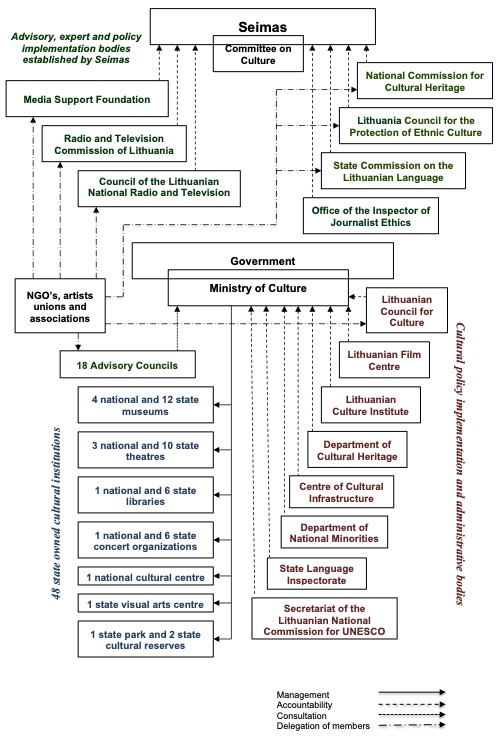
Figure 2. The organigram of the Ministry of Culture of the Republic of Lithuania

Last update: October, 2025
In Lithuania, State power is exercised by the Parliament (Lith. Seimas), the President of the Republic, the Government, and the Judiciary. The Seimas is the national legislative body composed of 141 members elected for a four-year term on the basis of universal, equal and direct suffrage by secret ballot. The Seimas Committee on Culture deals with various cultural development issues, discusses questions of current interest and adopts decisions, and analyses culture-related legislation. Advisory and expert bodies of Seimas are the National Commission for Cultural Heritage, the Radio and Television Commission of Lithuania, the State Commission of the Lithuanian Language, and the Council for the Protection of Ethnic Culture. All these institutions also have several cultural policy implementation functions. Their governing bodies are composed of members delegated by the Seimas, the President and/or NGO’s working in the relevant areas.
Three independent media policy institutions are established by and accountable to the Seimas: the Office of the Inspector of Journalist Ethics, the Council of Lithuanian National Radio and Television (LRT Council) and the Media Support Fund. LRT Council is the highest collegial governing body of Lithuanian Radio and Television Company, exercising management and supervisory functions, as well as representing the public interest. The Media Support Fund was created in 2023. It replaced the Press, Radio and Television Support Fund, which was established in 1996 and was the first independent cultural policy implementation body of the “arm’s length” type in Lithuania. The Media Support Fund has the legal form of a public institution (Lith. Viešoji įstaiga) that ensures its greater autonomy and independence from political institutions.
The Government of the Republic of Lithuania exercises executive power in Lithuania. The Ministry of Culture is an institution of the Government, which develops, organises, coordinates and controls the implementation of state cultural policy. The main functions of the Ministry of Culture, laid out in the Statute of the Ministry of Culture and other legal acts, are to draft laws and other legal acts regulating the field of culture; develop concepts and programmes for the development of various fields of art and coordinate their implementation; finance museums, libraries, fine arts, film, concert and other organisations, as well as important art and culture projects; coordinate the implementation of the system for the protection and enforcement of copyright and related rights; coordinate the implementation of state policy in the field of public information; ensure the registration and protection of cultural property; prepare and implement intergovernmental cultural programmes; draft international agreements; initiate the strategy for regional cultural development. The Ministry also approves annual activity plans and reports of 38 state cultural institutions (theatres, museums, libraries), and strategic plans of 10 national cultural institutions.
The Ministry of Culture has 18 advisory councils that provide advice and consultations on current issues of interests in different fields: Media Council, Literature Council, Council on Ethnic Culture and Intangible Cultural Heritage, Council for Cultural Education, Lithuanian Culture and Art Council, Library Council, Film Council, Museum Council, Council for Professional Performing Arts, Culture Centres Council, Council for Granting the Status of Art Creator and Organisation of Art Creators, Council for Digitisation of Lithuanian Cultural Heritage, Archive Council, Lithuanian Design Council, Song Festivals Council, Council for the Art of Architecture, Visual Arts Council, and Patronage Council. All these advisory councils are composed of representatives of non-governmental organisations active in the relevant fields of culture and persons delegated by ministries. The councils meet approximately 1 to 5 times a year, as needed.
The Ministry of Culture also have two departments dedicated to special areas – the Department of Cultural Heritage and the Department of National Minorities. The Department of Cultural Heritage is an institution responsible for implementing the national policy for the protection of immovable cultural heritage and movable cultural property (listed in the Register of Cultural Property). The main tasks of the Department are to coordinate and organise the process of recording and inventorying cultural heritage and to maintain the Register of Cultural Property; provide methodological guidance for the protection of cultural heritage and offer advice on the issues of the maintenance of cultural heritage; draw up programmes for the management and compensation of immovable cultural heritage and to organise their implementation; organise specific territorial planning for the protection of immovable cultural heritage; deal with issues relating to research into immovable cultural heritage and movable cultural property, organising and carrying it out; organise and coordinate international cooperation related to the protection of cultural heritage; organise and coordinate the identification and dissemination of knowledge of the immovable cultural heritage and movable cultural property. Currently, the structure of the Department consists of 8 central and 7 territorial divisions, the Cultural Heritage Research Board and the Heritage Conservation Library. The Department of National Minorities is an institution of the Government of the Republic of Lithuania involved in the formulation and implementation of national minorities policy. The Department compiles, systematises, analyses and summarises information on issues related to the implementation of the national minorities policy, drafts, coordinates and implements strategic planning documents in the field of national minorities policy; etc.
The two most independent cultural policy implementation bodies under the Ministry of Culture are the Lithuanian Council for Culture and the Lithuanian Film Centre. According to the Law on the Council for Lithuanian Culture, the Council consists of 10 members and a chairman. The members of the Council are elected in two rounds following the principle of proportional representation of all spheres of culture and arts, including all geographic regions. Both natural and legal bodies can delegate candidates to the first round of the elections. Out of them, 20 candidates are selected for the second round by a secret ballot cast by the voters delegated by culture and arts organisations. Out of the selected 20 candidates, the Minister of Culture selects 10 candidates to form the Council, that are submitted for the approval of the Government by following the principle of broad representation. The Chair of the Council is appointed to the office for a term of four years and dismissed from it by the Government on the recommendation of the Minister of Culture.
Functions of the Council for Culture, defined in the Law on the Council for Lithuanian Culture are as follows: to finance culture and art programmes, projects and other measures; award grants and provide other financial support to culture creators and artists; organise culture and art research and coordinate the implementation thereof; monitor culture and art projects being carried out; within its remit, prepare and submit conclusions concerning the awarding of prizes established by the Ministry of Culture; etc. The Council allocates state funding to cultural projects through calls for tender and makes financing decisions based on experts’ evaluations.
Activities of the Council are organised in accordance with a publicly announced annual operational plan approved by the order of the Minister of Culture. Priorities and objectives of the Council's activities and financed fields of culture and art, as well as result evaluation criteria, are laid down by the Minister of Culture in an annual operational plan of the Council. Council’s decisions are taken and executed by the Meeting of the Members of the Council and the Chair of the Council. The Chair of the Council heads the Council, the Meeting of the Members of the Council and the Administration of the Council.
The Lithuanian Film Centre is a budgetary institution under the Ministry of Culture of the Republic of Lithuania. The objectives of the Centre are to promote long-term development and competitiveness of Lithuanian cinema and participate in the formation of an efficient national film policy. The Centre coordinates national film production, administers state funds for the development of the cinema field: organises film project tenders for state funding, consults applicants, administers partial funding of production and promotion, exercises control over the use and reporting of state funding, represents Lithuania in foreign and international organisations, and organises the work of the Film Council that is a consulting body of the Centre. The activities of the Lithuanian Film Centre are organised according to the annual action plan approved by the Minister of Culture. The head of the Centre is the director, who is appointed and dismissed by the Minister of Culture for a four-year term and is directly subordinate and accountable to the Minister of Culture (see chapter 3.5.3 for more about the Film Centre).
Last update: October, 2025
There are no regional authorities in Lithuania. Since 1994, 10 higher administrative units, i.e. counties (Lith. apskritys), have functioned in Lithuania that had their own administration. In 2010, due to the administrative reform, counties were liquidated as administrative units, and since then, their territories function as geographical units only and do not have their own authorities.
Last update: October, 2025
In Lithuania, there are 60 municipalities. Municipality (Lith. savivaldybė) is a unit of the State territory and its community with a right to local (municipal) self-government guaranteed by the Constitution and exercised through the Municipal Council and through executive and other municipal institutions and bodies that are formed by the Municipal Council and are accountable to it. The Council is elected by residents of the administrative unit concerned. The municipality is a public legal entity headed by the mayor.
The local authorities in Lithuania have the right to establish committees (boards) to deal with cultural policy issues. All municipalities also have departments dedicated to the management of local cultural institutions, events and cultural heritage. Most of these departments are responsible not only for culture, but also for the management of education, sports, and tourism. Some municipalities also have culture and art councils that work as the municipality’s advisory bodies.
Last update: October, 2025
The main non-governmental bodies of the cultural community in Lithuania are various associations and unions. The Ministry of Culture of the Republic of Lithuania provides data on 19 artists’ associations that have a special status of “artists’ organisation” granted them according to the Law on the Status of Artists and Artists Organisations (1996): Architects’ Association of Lithuania, Lithuanian Union of Journalists, Lithuanian Theatre Union, Professional Folk Artists’ Association, Lithuanian Writers’ Union, Lithuanian Musicians’ Union, The Lithuanian Association of Literary Translators, Lithuanian Composers’ Union, Lithuanian Filmmakers’ Union, Union of Lithuanian Art Photographers, Lithuanian Designers’ Society, Lithuanian Artists’ Association, Lithuanian Association of Landscape Architects, Contemporary Dance Association, Lithuanian Interdisciplinary Artists’ Association, Association of Performing Arts Critics, Lithuanian Association of Chores, Association of Vilnius Region Folk Artists, Lithuanian Association of Art Creators. The latter organisation is an umbrella association of twelve unions of artists, listed above. It was established in 1995 and aims to coordinate cooperation between artists and artists’ organisations in Lithuania. The association represents the interests of Lithuanian professional artists and writers abroad, organises public debates between artists and politicians on the issues of the development of culture and arts, organises conferences, submits proposals on draft laws and regulations, and awards Lithuanian artists for outstanding professional works created in the last two years.
Members of the above-mentioned organisations delegate members or take part in the activity of many cultural policy bodies, such as advisory Councils of Ministry, Lithuanian Council for Culture, Council of Press, Radio, and Television Support Foundation, Radio and Television Commission of Lithuania, National Commission for Cultural Heritage, Council for the Protection of Ethnic Culture, State Commission on the Lithuanian Language, and Council of the Lithuanian Radio and Television Company (see chapter 1.2.1, the organigram of the Lithuanian cultural policy institutions).
Last update: October, 2025
The basic principles of the inter-ministerial and inter-institutional co-operation in Lithuania are formulated in the Law on Strategic Governance (approved in 2020) and the Strategic Governance Methodology (2021). Transversal cooperation at the national and local levels is mainly based on special inter-institutional action plans. These plans are approved by the government and provide for the distribution of tasks and activities of the cooperating parties, and performance indicators.
Another form of inter-institutional cooperation is working groups that are formed to address specific issues. Working groups are defined as advisory expert bodies that carry out specific tasks assigned to them by a certain ministry within a specified time frame. In 2025, the Ministry of Culture provides information about 10 inter-institutional working groups coordinated by the Ministry, although some of them have already finished their tasks. These working groups deal with various issues of cultural policy, such as the quality of the services of the Culture Pass program, the adaptation of the European Media Freedom Act into the national law of the Republic of Lithuania, etc. The working groups involve not only representatives from the Ministry of Culture and other ministries in addressing the tasks, but also experts from public organisations and state cultural institutions.
Last update: October, 2025
The Lithuanian cultural institutions system comprises 4 kinds of institutions: national, state, municipal and private, i.e. established by private persons or their organisations. These kinds of institutions are present in all main areas of culture: museums, theatres, libraries, cultural centres, etc.
Almost all national and state cultural institutions have the legal status of budgetary institutions, which is defined in the Law on Budgetary Institutions (1995, new edition 2024). According to the Law, the budgetary institution is a public legal entity with limited civil liability, which performs state or municipal functions and is maintained from the appropriations of the state or municipal budgets, as well as from the budgets of the State Social Insurance Fund, Compulsory Health Insurance Fund and other state monetary funds. Authorities exercising the rights and obligations of the owner approve the statutes of a budgetary institution, appoint and dismiss the head, decide on the reorganisation or liquidation of the budgetary institution, take a decision regarding the establishment of a branch of a budgetary institution and the termination of its activities, etc.
In 2025, there were 10 national cultural institutions in Lithuania: 3 theatres (the Lithuanian National Opera and Ballet Theatre, the Lithuanian National Drama Theatre, and National Kaunas Drama Theatre), 4 museums (National Museum of Lithuania, Lithuanian National Museum of Art, Palace of the Grand Dukes of Lithuania, M. K. Čiurlionis National Museum of Art), 1 library (Martynas Mažvydas National Library of Lithuania), 1 concert organisation (Lithuanian national Philharmonic Society), and 1 broadcasting company (Lithuanian National Radio and Television). National institutions themselves manage the appropriations that are allocated to them each year by the government in accordance with the Law on the Approval of Financial Indicators of the State Budget and Municipal Budgets, which is adopted by the Seimas each year.
State cultural institutions are financed through the Ministry of Culture, i.e. the Ministry allocates their appropriations according to its budget plan for the respective year. In 2025, cultural services are provided by 39 state cultural institutions under the purview of the Ministry: 12 museums, 10 theatres, 6 libraries, 6 concert organisations, 1 arts centre, 1 cultural centre, 1 park and 2 cultural reserves. There are also four state museums that are financed by other Ministries – the Ministry of Education, Science and Sport, the Ministry of National Defence and the Ministry of Environment. Most of these state cultural institutions are concentrated in the three largest cities of Lithuania.
Local authorities are responsible for the financing and maintenance of local cultural institutions and cultural heritage. They have the right to establish or abolish cultural institutions of local importance and finance them through appropriations from the local budget. Every municipality in Lithuania has at least a local museum, library and cultural centre. Most of these organisations have a legal form of budgetary or public institutions, and their owner is the municipality. According to the data of the National Library, in 2024, there were 1115 municipal public libraries, 934 of them were located in rural areas. LIMIS (Information System of Lithuanian Museums) provides information on 63 municipal museums, although according to the data of the Official Statistics Portal, in 2024, there 54 municipal museums in Lithuania. The number of museums fluctuates due to changes in their administration – in some municipalities, separate museums are merged and become a single administrative unit with several branches. According to the data provided by municipalities themselves on their websites about their cultural institutions, in 2025, there were in Lithuania 10 municipal theatres, 6 concert organisations and 146 cultural centres with 462 structural subunits.
Data on private cultural institutions in Lithuania are not systematically registered. According to the Official Statistics Portal, in 2024, there were 53 private theatres and 54 private museums in Lithuania. However, the Register of Legal Entities provides information on 120 registered organisations with the word “theatre” in their name that have the legal form of NGO, individual enterprise, etc. The Directory of Private Museums provides data on 109 private museums. LIMIS (Information System of Lithuanian Museums) provides information on 85 private museums and 34 institutional/departmental museums, such as the Railway Museum of Lithuanian Railway company, Lithuanian Police Museum, Money Museum of the Bank of Lithuania, etc. Some museums have several owners, and because of that, it is complicated to attribute them to one category.
In the field of cultural heritage protection and use, all three types of ownership – state, municipal, and private – are also present. According to data from the Register of Cultural Properties of Lithuania, in 2025, there were 2,355 immovable cultural heritage objects (buildings and sites) that held the status of national cultural monuments and were protected by the state. An additional 8,156 objects were designated as state-protected heritage sites, while 134 objects were protected by municipalities. A further 13,288 objects were listed in the register but did not yet hold any formal protection status. However, no data is available on how many of these properties are privately owned.
Last update: October, 2025
Table 1: Cultural institutions, by sector and domain
|
Domain |
Cultural institutions (subdomains) |
Public sector |
Private sector |
||
|
|
|
Number (2025) |
Trend last 5 years (In %) |
Number (2025) |
Trend last 5 years (In %) |
|
Cultural heritage |
Cultural heritage sites (recognised)** |
10 645 |
+1,36 |
NA |
NA |
|
|
Archaeological sites** |
4 459 |
NA |
NA |
NA |
|
Museums |
Museum institutions* |
99 |
+3.1 |
12 |
+20 |
|
Archives |
Archive institutions* |
9 |
0 |
NA |
NA |
|
Visual arts |
Public art galleries / exhibition halls*** |
25 / 186 |
NA |
28 |
NA |
|
Performing arts |
Scenic and stable spaces for theatre**** |
130 |
0 |
NA |
NA |
|
|
Concert houses |
4 |
NA |
1 |
NA |
|
|
Theatre companies* |
23 |
0 |
53 |
+47 |
|
|
Dance and ballet companies***** |
5 |
0 |
12 |
NA |
|
|
Symphonic orchestras |
4 |
0 |
0 |
0 |
|
Libraries |
Libraries* |
2136 |
-7.3 |
NA |
NA |
|
Audiovisual |
Cinemas****** |
6 |
0 |
15 |
-1.6 |
|
|
Broadcasting organisations******** |
1 |
0 |
65 |
-5.8 |
|
Interdisciplinary |
Socio-cultural centres / cultural houses* |
608 |
-4.1 |
NA |
NA |
|
Other (please explain) |
|
|
|
|
|
Sources:
*Data from the Official Statistics Portal
**Data from the Register of Cultural Properties of Lithuania, the number includes the state and municipalities’ protected immovable heritage objects and immovable cultural monuments.
***7 galleries belong to the National Museum of Art; 5 galleries belong to M. K. Čiurlionis National Museum of Art. The Contemporary Arts Centre has Special exhibition halls; 12 galleries belong to or are partly funded by municipalities. 186 specialised exhibition halls are accommodated in cultural houses (data from the National Cultural Centre). Data about private galleries fluctuates and is approximate: Lithuanian Artists’ Association has 10 galleries; Lithuanian Photographers association has 4 galleries; there is 1 private modern art museum with exhibition halls and 12 active private galleries.
****In Lithuania, there are 146 cultural centres with 608 branches. They house 130 large halls (from 201 to 800 seats) and 100 small halls (from 50 to 200 seats) (data from the National Cultural Centre)
*****Data from Lithuanian Dance Information Centre
*******Data from Lithuanian Film Centre
********Data from the Radio and Television Commission of Lithuania
Last update: October, 2025
The network of state cultural institutions in Lithuania has changed very little over the past 30 years. Some museums were merged, combining several smaller museums into a single administrative unit with branches, while some museums gained new departments after being entrusted with the operation of newly restored heritage buildings. For example, in 2012, the National Museum of Art was given a newly restored building that became the Vytautas Kasiulis Art Museum and houses the collection of the artist’s works and personal archive donated to Lithuania in 2010 by the painter’s widow, Bronė Kasiulienė, and transferred to the Lithuanian Art Museum by their son, Vytautas Kasiulis. Some private theatres, born out of purely private artistic initiatives, eventually began receiving stable support from municipalities. For example, the independent dance group “Aura,” founded in 1980 by choreographer Birutė Letukaitė, became a municipal theatre of the city of Kaunas in 1995. Founded in 2006, the theatre troupe “Bohemians” became the public institution Vilnius City Opera in 2012, with the Vilnius Municipality as one of its stakeholders.
The efficiency and relevance of the state cultural institutions network in providing the population with the necessary cultural services were examined and evaluated several times by the National Audit Office of Lithuania and by experts who conducted special studies. Many of these studies revealed that there is no clear difference between the national and state institutions, their activities and their performance evaluation. For example, the purpose of national theatres, defined by the Law on Professional Performing Art, is to present the most outstanding national and foreign achievements of opera, ballet, drama and music art; represent the creation of high artistic value; form the image of Lithuanian culture; develop international creative partnership; and ensure access to professional performing arts for all societal groups of the country. The purpose of state theatres is to develop a distinctive trend of professional performing arts; present classical and contemporary professional performing arts works of high artistic value in Lithuania and abroad; develop public demand for professional performing arts; and ensure access to professional performing arts for all societal groups of the country. The evaluation of the achievement of these purposes, however, lacks clear methods and is mostly based on quantitative indicators that do not necessarily show the artistic quality of the performances and of the overall creative programme of the institution.
The lack of a unified, clear and comprehensive system of evaluation is one of the basic problems of the Ministry of Culture’s management of the state cultural institutions system. Quantitative data is collected only on state institutions, mainly museums and theatres; the municipal and private sectors are not reflected in this data, and qualitative data, even about state institutions, is collected in a very sporadic way. Without the qualitative evaluation criteria of the performance of institutions, the evaluation is incomplete, since the quantitative criteria do not reflect changes in public attitudes, results of expert evaluations, etc. As a result, the Ministry of Culture does not have the data needed to measure the quality of the institutions’ performance and cannot tie the funding of institutions with the quality of their performance.
The other problem of the state cultural institutions network, stated in the Lithuanian Cultural Policy Strategy 2030 and reiterated in the Culture and Creativity development programme 2021 –2030, is its unevenness in terms of accessibility. The main professional cultural institutions are concentrated in the major cities, and the services they provide are not evenly accessible throughout the territory of Lithuania. The accessibility of high artistic value cultural services reached only 28 per cent in 2019, and the goal stated in the Culture and Creativity development programme is to improve this indicator to 50 per cent by 2030. Culture is the least accessible in villages and small towns. To address this strategic issue, the Ministry of Culture has undertaken or plans to finance various cultural mobility activities, such as travelling museum exhibitions, free exchange of books and other documents between the country’s libraries, upgrading cultural institutions’ infrastructure and adapting it for people with disabilities, as well as adapting various services (media, book reading, museum exhibitions) for people with disabilities, taking performing arts productions of national and state theatres to the country’s regions, and so on.
Last update: October, 2025
The Ministry of Culture of the Republic of Lithuania is the main coordinator of international cultural cooperation and the internationalisation of culture policy. In 2018, the Ministry of Culture adopted the Concept of the Culture Internationalisation Policy that defines the goal, objectives and evaluation indicators of the culture internationalisation policy. According to the Concept, the goal of the internationalisation policy is to advance the internationalisation of Lithuanian culture in pursuance of the diversity of cultural expressions, enhance the quality and competitiveness of creative products and cultural services, and contribute to the development of an open and dynamic society that is able to perform in an ever-changing world.
The Ministry of Culture coordinates the interface of the culture internationalisation policy with the objectives of foreign and economic policy with the Ministry of Foreign Affairs, the Ministry of Economy and the Chancellery of the Government. The Minister of Culture also forms an Integrated Culture Internationalisation Policy Management Group that consists of 5-7 members.
The function of the representation of Lithuanian arts and culture abroad is performed by the Lithuanian Culture Institute. The institute organises and coordinates programmes for the presentation of Lithuanian culture; implements the Visits Programme, aimed at bringing foreign culture professionals to Lithuania to familiarise themselves with the Lithuanian art scene; organises the Translation Funding Competition; cooperates in the preparation and coordinates the implementation of cultural attachés’ activities; coordinates Lithuania’s participation in the European Union programme Creative Europe; prepares and disseminates information about Lithuanian culture and professional art; within its competence, provides consultations, shares knowledge, and participates in inter-institutional activities.
Culture attachés working in diplomatic missions of Lithuania also represent Lithuanian arts and culture abroad. In 2025, 10 cultural attachés worked in France, Germany, Italy, Japan, Poland, Sweden, the USA, Ukraine, the UK and Israel. The main purpose of the activities of attaches is to help Lithuanian artists, cultural and creative institutions and companies to reach the international market, support professionals in the cultural and creative sectors while seeking long-term international cooperation and on the basis of their activity, to present Lithuania and Lithuanian culture in foreign countries.
The Lithuanian Film Centre also contributes to the internationalisation of Lithuanian culture. The centre organises national stands at events such as the European Film Market in Berlin and the Marché du Film in Cannes, showcasing new Lithuanian films and fostering industry partnerships. The Centre also presents restored classics at events like the International Classic Film Market in Lyon, highlighting Lithuania’s film heritage. In addition, it supports the international screening of Lithuanian short films and emerging directors’ works, for example, at the Tampere Film Festival in Finland.
Last update: October, 2025
Lithuania joined UNESCO in 1991. In 1992, the Lithuanian National Commission for UNESCO was established, and the Permanent Delegation of the Republic of Lithuania to UNESCO was established in 1993. The Secretariat of the Lithuanian National Commission for UNESCO serves the Lithuanian National Commission for UNESCO and supports the implementation of its decisions. The Ministry of Culture of the Republic of Lithuania coordinates the implementation of the UNESCO conventions and decisions (see the list of UNESCO conventions ratified by Lithuania in chapter 4.2.1).
Lithuania became a member of the Council of Europe on 14 March 1993. In 2025, Lithuania participated in the following cultural initiatives of the Council of Europe: EURIMAGES – European Cinema Support Fund, national coordinator is Lithuanian Film Centre; European Audiovisual Observatory, national coordinator is Lithuanian Film Centre; Compendium of Cultural Policies and Trends, national coordinator is Lithuanian Council for Culture; HEREIN: Observatory on policies and values of the European heritage, national coordinator is Department of Cultural Heritage under the Ministry of Culture; European Heritage Days, national coordinator is Department of Cultural Heritage under the Ministry of Culture.
Lithuania became a member state of the European Union in 2004. Since then, Lithuania has participated in the EU programs European Capitals of Culture, Creative Europe, Europe for Citizens, Horizon and Horizon Europe. Currently, the Lithuanian Science Council coordinate the network of Horizon Europe national contact points in Lithuania. Participation of Lithuania in the Creative Europe Programme is coordinated by the Lithuanian Culture Institute, which is responsible for the CULTURE sub-programme, and the Lithuanian Film Centre, which is responsible for the MEDIA sub-programme. Information about the programme Creative Europe is provided by the Lithuanian office of Creative Europe.
Lithuania takes part in the Council of the Baltic Sea States, established in 1992. The Council is an overall political forum for regional cooperation. It aims to develop and foster the concept of Baltic Sea Region identity and a sense of belonging to the Baltic Sea Region through engagement, dialogue, people-to-people contacts, macro-regional networks and multilevel governance. To this end, several activities, programmes and networks are operational within the priority. This includes the Baltic Sea Monitoring Group on Heritage Cooperation, focusing on preservation of the common heritage in the Baltic Sea States, and specifically on building preservation and maintenance in practice, underwater heritage, coastal culture and maritime heritage, and sustainable historic towns. The national coordinator of the project is the Department of Cultural Heritage under the Ministry of Culture of the Republic of Lithuania.
In 1991, the Ministries of Culture of the Baltic Sea Region created the Ars Baltica network that was aimed at encouraging cultural collaboration. Ars Baltica supports cultural cooperation within the Baltic Sea Region and beyond, advocates for the significance of arts and culture on the political level and promotes cultural life around the Baltic Sea. It is a cultural framework, gathering and offering information on different aspects within the arts and culture sector through network building and by supporting the implementation of multilateral cultural projects.
In 1991, the Baltic countries started to cooperate with the Nordic Council of Ministers. The Nordic Council of Ministers’ Office in Lithuania was established in 1991. The Office promotes Nordic culture in Lithuania and encourages Nordic-Lithuanian cultural cooperation. Since 2009, the Lithuanian Ministry of Culture has participated in the Nordic-Baltic Cultural Mobility Programme, which is coordinated by the Nordic Council of Ministers and consists of 3 modules: networking, art residencies and artist mobility.
Lithuania also cooperates with the two other Baltic States. Cooperation between the three Baltic States is based on the trilateral Treaty on Concord and Cooperation, signed on September 12, 1934, in Geneva. The Declaration on Unity and Cooperation, signed on May 12, 1990, in Tallinn, in full scope restored the cooperation between Lithuania, Latvia and Estonia.
Within the framework of Baltic co-operation, active dialogue is ongoing at the level of Presidents, Speakers of Parliaments, Heads of Government, Ministers and experts. Baltic Parliamentary Cooperation takes place in the Baltic Assembly, which was established on November 8, 1991. Since 1993, the Baltic Assembly has annually awarded a prize for achievements in literature, arts, and science. Intergovernmental co-operation of Baltic states takes place in the Baltic Council of Ministers, founded on 13 June 1994. The Baltic Council of Ministers is a regional organisation that promotes intergovernmental cooperation between Estonia, Latvia, and Lithuania. It attempts to find a common position in relation to many international issues, including economic, political and cultural issues.
Trilateral cooperation in the field of culture is coordinated by the Baltic Cultural Committee of senior officials, who meet annually to discuss cooperation issues. Cultural cooperation guidelines are provided by the Programme of Cultural Cooperation, signed between all three Ministries of Culture in 1994. The programme is regularly renewed. The current programme is designed for the period 2023-2026 and proposes to continue such long-term joint projects as Baltic Museology Summer School, the international chamber orchestra of three Baltic States Kremerata Baltica, and to foster collaboration with Baltic Film and Media School, Baltic Drama Forum, Baltic Dance Platform, Baltic Architects’ Unions Association, etc.
As of 2019, the Lithuanian Ministry of Culture participates in the Baltic Culture Fund programme. The main goal of the Baltic Culture Fund, founded on 8 July 2018 on the basis of Agreement between the Ministries of Culture of the Republic of Lithuania, Republic of Estonia and Republic of Latvia on the Establishment of the Baltic Culture Fund, is to promote cultural cooperation between the Baltic countries and strengthen the internationalisation of Lithuanian, Estonian and Latvian culture through joint cultural projects and events. Grants are awarded annually. The Fund is administered by national cultural endowments on a three-year rotation basis. The Cultural Endowment of Estonia was the first to coordinate the Fund’s activities from 2019 to 2021. In 2022, the coordinator of the Fund became the Latvian State Culture Capital Foundation. The application rounds in 2025-2027 are hosted by the Lithuanian Council for Culture. Each Baltic country contributes 100,000 EUR to the Fund annually.
Last update: October, 2025
International professional cooperation in the non-governmental sector proceeds through professional networks, cooperation projects and participation in international events. All these activities can compete for funding by participating in the Lithuanian Council for Culture’s funding programmes aimed at the promotion of international cooperation or culture dissemination, such as “Cultural and Creative Industries: Networking”, “Strategic Funding of International Events”, and the Lithuanian Culture Institute’s “Visit Programme”.
Some Lithuanian NGOs organise long-term international events that, among other functions, serve as a hub for the maintenance of international cultural relations and cooperation. Lithuanian Publishers Association, together with Lithuanian Culture Institute and Lithuanian Exhibition and Congress Centre LITEXPO, organise the Vilnius Book Fair, which is the largest annual book fair in the Baltic states and hosts an international forum and discussion club of publishers, writers and other artists. NGO Vilnius festivals organises an international theatre festival Sirenos that hosts the Lithuanian Theatre Showcase. Sirenos is a member of the international network of theatre organisations, IETM (Informal European Theatre Meeting). The Lithuanian Art Gallerists’ Association organises ArtVilnius, which is the largest event of visual arts in Eastern Europe. Every year, foreign galleries and museums take part in it, and international projects of artists are presented.
Several of the main Lithuanian artists’ organisations and unions participate in international professional networks. The Lithuanian Association of Artists takes part in the International Association of Art (IAA) Europe. The IAA is a network of about 40 national member organisations within Europe, representing professional visual artists. The IAA supports international cooperation and artistic exchange, aims to improve the economic and social position of artists on a national and international level, cooperates with UNESCO and is engaged with other organisations concerned with the arts and culture.
The Architects Association of Lithuania is a member of the International Union of Architects, the Architects’ Council of Europe and the Baltic Architects Unions Association (BAUA). The International Union of Architects is an international non-governmental organisation recognised by UNESCO as the only architectural union operating at an international level. The Architects' Council of Europe is a non-profit organisation founded in 1990 that aims to promote architecture in Europe, advance architectural quality in the built environment, ensure high standards of qualification for architects, etc. The Baltic Architects Unions Association’s mission is to promote the growth of architectural practice in the Baltic States.
The Lithuanian Journalists Union is a member of the International Federation of Journalists and the European Federation of Journalists. The International Federation of Journalists organises collective action to support journalists’ unions in their fight for fair pay, decent working conditions and in defence of their labour rights; promotes international action to defend press freedom and social justice through strong, free and independent trade unions of journalists; fights for gender equality in all its structures, policies and programmes; opposes discrimination of all kinds and condemns the use of media as propaganda or to promote intolerance and conflict; and believes in freedom of political and cultural expression.
The Lithuanian Writers’ Union is a member of the Baltic Writers’ Council (BWC) (seated in the island of Gotland, Visby, Sweden), which unites creative organisations of writers and translators from Northern Europe. It is the most important organisation bringing together European writers’ unions. The Lithuanian Writers’ Union is also a member of the Three Seas Writers’ and Translators’ Council (seated in Rhodes, Greece).
The Lithuanian Association of Literary Translators is a member of the European Council of Associations of Literary Translators (CEATL), the International Federation of Translators (FIT), the Baltic Writers’ Council (BWC) and the Three Seas Writers’ and Translators’ Council (TSWTC).
The Lithuanian Association of Cultural Centres is a member of European Council of Artists that promotes co-operation between artists in safeguarding their political and cultural position within Europe, with special focus on the policies of the European Union, the Council of Europe, UNESCO and other relevant organisations and on promoting the interests of professional artists in political, economic, judicial and social contexts.
The Lithuanian Composers’ Union is a member of the International Society for Contemporary Music (ISCM). ISCM is a premier forum for the advancement, dissemination and interchange of new music from around the world. Through ISCM, our members promote contemporary music in all its varied forms, strengthening musical life in their local contexts and making their music and its creators known to the world.
Many Lithuanian NGOs cooperate with their partners abroad through joint events, festivals, masterclasses, etc. The Lithuanian Professional Folk Artists’ Association cooperates with the Polish Folk Artists’ Association (Stowarzyszenie tworcow ludowych, STL), the Latvian Folk Artists’ Association, the Lithuanian High School in Hüttenfeld, Germany, Bialystok Crafts Centre (Poland), the Lithuanian Culture House in Puńsk (Poland), Saint-Egreve (France) Water-colourists’ Club, Boxholm (Sweden) organisation Friends to Friend. The Lithuanian Designers’ Association has been a full member of ico-D (International Council of Design) since 1999. In 2019, the Association became a member of ADCE – The Art Directors Club of Europe. ADCE is a platform that brings together creators in advertising, design, and communications from European countries. Its mission is learning, exchanging ideas, and fostering creativity and collaboration. Membership in this organisation increases the visibility of Lithuanian visual communications professionals in international markets and strengthens the local community of design creators.