
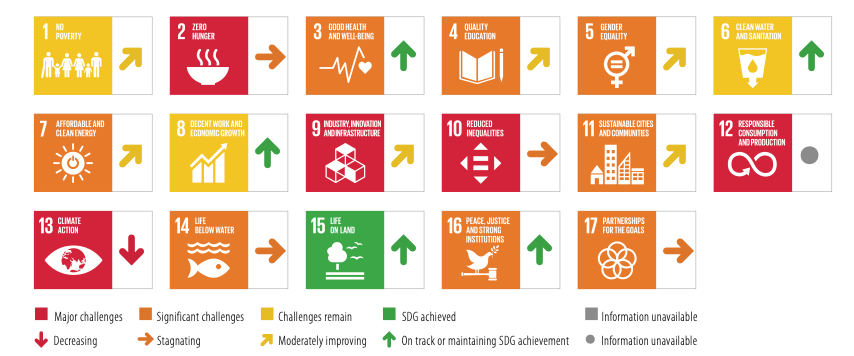
According to the UN Sustainable Development Goals Index, in 2025 Lithuania’s SDG Index score was 78.81, and it ranked 29th out of 167 countries. The best result Lithuania has so far achieved in SDG1 (no poverty) and SDG15 (Life on land). The biggest challenges are related to the achievement of 2nd, 12th, 13th, goals.
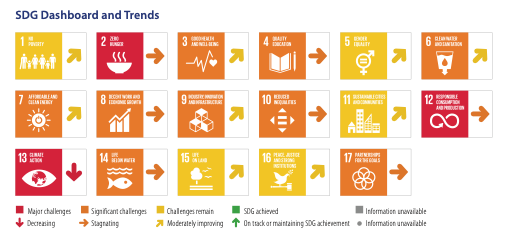
Figure 3. Lithuanian SDG trends in 2025
Source: Sustainable development report, country profiles
The National Development Plan of Lithuania for 2021-2030 declares sustainable development a horizontal priority and sets the target for Lithuania to be in the top 20 countries in the Sustainable Development Index by 2030. The Plan also sets ten strategic goals to be achieved over the next 10 years that are linked to UN Sustainable Development Goals: 1) to pass to the sustainable development of the economy based on scientific knowledge, advanced technologies and innovations and to increase the country’s international competitiveness; 2) to increase the social well-being and inclusion of the population, to strengthen health and to improve the demographic situation in Lithuania; 3) to increase the inclusion and effectiveness of education in order to meet the needs of the individual and society; 4) to strengthen national and civic identity, increase the spread of culture and the creativity of society; 5) improving transport, energy and digital internal and external connectivity; 6) to ensure good quality of the environment and sustainability of the use of natural resources, protect biological diversity, mitigate the impact of Lithuania on climate change and increase resilience to its impact; 7) to develop the territory of Lithuania in a sustainable and balanced manner and reduce regional exclusion; 8) to increase the efficiency of the legal system and public administration; 9) to strengthen global Lithuania’s influence and relations with the diaspora; 10) to strengthen national security. The National Development Plan for 2021 – 2030 also encompasses the objectives of each goal and its achievement indicators.
The Lithuanian Ministry of Culture is mostly involved in the realisation of the fourth goal of the Plan, which is “to strengthen national and civic identity, increase the spread of culture and the creativity of society”. This goal is linked to the 4th, 8th, 10th, and 11th SDGs of the UN and entails 7 objectives: 4.1. encourage the population to participate in cultural activities and contribute to the development of culture; 4.2. improve creation conditions in Lithuania and increase the dissemination of Lithuanian culture abroad; 4.3. promote the integration of national minorities; 4.4. aim to increase the highest achievements of Lithuanian sport; 4.5. strengthen the relevance of historical memory in society; 4.6. revive the cultural and national heritage of public significance and increase its usage for the needs of the society; 4.7. increase the relevance of the Lithuanian language in the context of globalisation and technology.
In 2021, the National Audit Office of Lithuania prepared a report on Lithuania’s preparedness to implement sustainable development goals. The report has indicated some important aspects of SDG implementation that have to be improved. First, there is a lack of an effective inter-institutional coordination mechanism that results in insufficient coordination of the implementation of the SDGs, both between state institutions (horizontal coordination) and with municipalities and other institutions (vertical coordination). Also, there is no national coordination on publicising the SDGs, and no publicity plan to ensure targeted public communication involving state institutions and other stakeholders. According to surveys (2019), only 24% of Lithuanians have heard of the SDGs or were well aware of them. Secondly, Lithuania does not have an effective mechanism to monitor data and assess progress towards SDGs. Shortcomings in the localisation of indicators and data collection make it difficult to adequately monitor progress in the implementation of the targets and to react to possible negative trends in indicators in a timely manner.
Despite these shortcomings of sustainable development policy at the governmental level, the NGO sector is aware of SDGs and participates actively in various sustainable development activities. According to the Voluntary National Review on the Implementation of the UN 2030 Agenda for Sustainable Development in Lithuania, prepared by an interinstitutional workgroup in 2023, the involvement of NGOs in the 2030 Agenda is promoted in different formats. In 2023, to support NGO activities related to climate policy development and public awareness on climate change, the Ministry of Environment has granted EUR 0.5 million. The Nordic Council of Ministers Office in Lithuania regularly implements support programmes to strengthen the country’s sustainability and to educate young people about the SDGs. Cultural NGO are mostly involved in the activities designed to introduce the United Nations 2030 Sustainable Development Goals to the Lithuanian public. They organised documentary film festivals, photography exhibitions, interactive events, ‘brain fights’ and discussions, disseminate information on television and radio shows and social media, and look for innovative, attractive and accessible forms to present the information.
Comments are closed.