
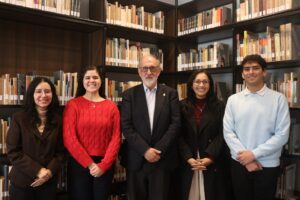
 Pictured L-R are María Fernanda Flores,
María Alejandra Salgado,
Dr. Enrique Banús, María Llana, Joshua Díaz
Our special thanks for their efforts and commitment go to the policy experts of the Cultural Policy Research Group at the Department of Cultural Management, University of Piura, Peru:
- Dr. Enrique Banús, full professor in the Department of Cultural Management and head of the university’s Office of Cultural Heritage and Cultural Center
- Joshua Díaz, student member of the research group
- María Fernanda Flores, student member of the research group
- María Llana: archaeologist, coordinator at the university’s Office for Cultural Heritage
- María Alejandra Salgado, assistant at the Department of Cultural Management
Cultural policy in Colombia in transition
From the cultural economy to cultural diversity
Colombia has a population of 53 million, making it the second most populous country in South America. Almost four-fifths of its inhabitants live in urban areas. The country has a decentralized urban structure; in addition to its four cities with over a million residents, there is a large number of regional medium-sized cities with populations ranging from 200,000 to 600,000.
Mestizos (with European and indigenous ancestors), make up the largest share of the population at 47 percent, followed by 40 percent of people of European descent (white descendants of colonialists). Around 6.7 percent of the population have African ancestry, while indigenous peoples account for 4.3 percent. Colombia is a presidential republic, with its current constitution adopted in 1991. The current president, Gustavo Petro, was elected in 2022 as Colombia’s first left-wing president.
The 1990s: Ministry of Culture and Culture Law
In 1997, Colombia established a Ministry of Culture, following the 1991 Constitution, which places obligations on the state to ensure access to culture and promote cultural development. Article 3 of the 1997 Culture Act (Ley General de la Cultura) defines the role of the Ministry, which is tasked with coordinating state initiatives aimed at “educating new citizens” in line with the 1995 National Development Plan. The law also set a goal that was widely discussed in international documents of that decade: integrating cultural development into broader social and economic development. These reforms were driven by President Ernesto Samper, a long-time member of the social-liberal Colombian Liberal Party (Partido Liberal Colombiano).
The 2000s: Creative and cultural industries as the favorite child
Soon, the cultural economy appeared on the horizon in this context and became a focal point of cultural policy in Colombia in the new millennium.
In 2001, under Conservative President Andrés Pastrana (1998-2002), the National Culture Program for the next ten years was published. The promotion of small and medium-sized enterprises in the cultural sector was given top priority; a year later, the accompanying guidelines stated that “culture generates creative processes with high potential to contribute to economic growth,” but also that it has “a significant influence on the way of life of social groups.” The cultural industry is explicitly recognized as having the potential to make a significant contribution to economic growth, although in 1999 it accounted for only 0.91 percent of the country’s gross domestic product.
Under Pastrana’s successor, Álvaro Uribe (2002–2010), these initiatives became more concrete. This was followed in 2010 by the “National Policy for the Promotion of the Cultural Industry in Colombia,” which introduced a series of supporting measures.
The 2010s: Orange turns into the color of the Moment
Under Juan Manuel Santos (2010–2018), a new development program called “All for a New Country” was launched for the period 2014–2018. It was in this context that the magic term economía naranja—the orange economy—first appeared. In both Spanish and English, this color-based label for the cultural and creative industries quickly gained popularity and is widely considered a Colombian innovation. According to the program, the government aims to “make human talent a decisive factor in economic development.” The initiative includes support for the film industry, the arts, dance, and activities connected to historical culture. Here—as in later versions of such cultural policies—the economic is intended to serve the social: broad participation based on talent is seen as a means of fostering cohesion within society.
The so-called “Orange Law” from 2017 defines the cultural industry as one that “creates value on the basis of intellectual property.” Although this impetus is often attributed primarily to conservative President Iván Duque (2018-2022), it has a long history: under various center-right presidents (if they can be described as such, despite their differences), it has been integrated into the respective development programs; it already took center stage under Santos, and Duque has reinforced this trend. As a member of the Senate in 2013, he had already advocated in a report he wrote together with Felipe Buitrago for the Inter-American Development Bank for promoting activities “that enable ideas to be transformed into cultural goods and services.” As president, he saw this as a tool for transforming the economy and culture and adapting to a changing world in which knowledge-based industries are increasingly calling the shots. The institutional framework was completed with the creation of the “National Council of the Orange Economy” and a Vice Minister for Creativity and the Orange Economy, both in 2018. In 2020, this even led to the “Integrated Policy for the Creative Economy.”
What were the effects of all these measures? According to the government’s statistical office, at the start of Duque’s presidency in 2018, the creative industries accounted for 1.2 percent of the annual budget, rising to 1.5 percent in the following years—a modest increase. In contrast, the sector’s share of gross domestic product grew to 3.5–4.0 percent. The president proudly noted that the creative industries’ contribution was three times higher than that of the coffee industry. However, it is important to note that design, digital media, software, advertising, and related fields make up around 45.6 percent of the creative industries. Employment in the sector also saw substantial growth, increasing from 650,000 jobs in 2018 to 750,000 four years later—even despite the pandemic. Certain measures had a particularly strong impact: by law, companies in this sector could be exempt from taxes for seven years. According to a report from May 2020, 199 companies had already taken advantage of this benefit since the law came into effect in 2018.
Not everything in the program was tailored to the economy: for example, 29 percent of the country’s municipalities participated in the “Libraries as Peace Scenarios” project. And in addition to the usual support measures, training courses for cultural managers were added during the pandemic.
In terms of economic data, the results of the program are impressive. However, the orange economy has also been the subject of widespread criticism. By prioritizing what is profitable, cultural forms of expression that are not mediated by the market have been rendered invisible. Diego Armando Cordero Villarreal titled his 2024 publication “Orange Economy: A Look at the History of a Failure” because the social impact lagged far behind the economic impact.
2022: The turning point and the new cultural policy approach
After many years of similar governments, a major turning point came in 2022. Even during the election campaign, Daniel Rojas from the campaign team of the now incumbent president Gustavo Petro distanced himself from the exclusive strategic focus on the creative industries: “The orange economy is a concept that we have been trying to understand for four years and still do not understand.”
Gustavo Petro’s new cultural policy aims above all to take greater account of the country’s diversity. According to official figures, 115 indigenous groups live together in Colombia, speaking around 65 different languages. Almost 10 percent of the population identifies as Afro-Colombian. The renaming of the Ministry of Culture to “Ministerio de las Culturas, las Artes y los Saberes,” abbreviated as MiCaSa (roughly translated as Ministry of Cultures, Arts, and Wisdom, whose acronym can also be translated as “My House”), reflects this new orientation.
The government is concerned with social change. In 2024, then-Minister Juan David Correa declared that “there will be no social change without cultural change. Culture is where we are, where we live. We are not outside of culture; we do not exist outside of cultures.” The state must be rethought in terms of culture, as a human right and a pillar of sustainable development.
This new cultural policy is based on two important documents: the new national cultural program and the new cultural law. After several years of development, the National Cultural Program 2024-2038 was adopted in a participatory process with more than 90,000 contributions from society under the motto “Culture for the preservation of diversity, territory, and peace.” Three major areas of work run through the program: diversity and intercultural dialogue, memory culture and creation, governance and cultural sustainability. The program takes a strategic view of the cultural and creative industries—not as a productive sector, but as an essential component of citizenship, memory culture, and sustainability. When the program was presented in parliament, the main priorities identified were the promotion of artistic and cultural education; cultural spaces for living; the economy of the people; memories, knowledge, and biocultural areas; the culture of peace; and the promotion of Colombian culture around the world .
Since May 2025, a draft bill has also been before Parliament to amend the 1997 Culture Act. The programs for the individual cultural sectors were also presented in May.
According to the government, all these activities at the legislative and administrative level are backed up by concrete measures, such as increasing the culture budget, building cultural facilities, and launching new funding programs. However, stability will be crucial in a ministry where frequent changes have been the norm: four different ministers from three different political groups have taken turns since August 2022.
While the tone was—as usual—very confrontational during the election campaign, there now seems to be a certain effort to maintain continuity, at least in terms of language; “economía” remains, which in the current model ensures that entrepreneurship is also included and thus has an integrating effect. Whereas previously the term “economía creativa” was used, it is now “economías culturales y creativas” – the plural form and the doubling of the adjectives testify to the desire to broaden the scope.
An interim conclusion
After three years, it is still too early for a more in-depth assessment of the reorientation. There is still a spirit of optimism that is widely shared by those actively involved in cultural life. There are high expectations, but also the question of whether the state will be able to support this development financially and institutionally over the years, for a policy that understands culture as a human right and not just as a productive sector. Professor Felipe Londoño, an attentive and active expert on cultural life, sums it up: “The challenge is to translate the new approach into effective management and consistent budgets.” The country is transforming from a cultural policy focused on entrepreneurship to one focused on community, memory culture, and diversity. Both directions recognize the value of culture, but they do so from radically different visions of development and the role of art in social life.
Hopefully, the proclaimed commitment to integration in the new cultural policy will truly foster dialogue—in a society like Colombia’s, where it is so urgently needed.
Comments are closed.